Standard VII: The institution is governed and administered in a manner that allows it to realize its stated mission and goals in a way that effectively benefits the institution, its students, and the other constituencies it serves. Even when supported by or affiliated with governmental, corporate, religious, educational system, or other unaccredited organizations, the institution has education as its primary purpose, and it operates as an academic institution with appropriate autonomy (I.1.001.MSCHE_Standards_RoA).
Summary Declaration
To realize our mission and achieve our vision of being a pre-eminent and inclusive student-focused research university, preparing engaged citizens, scholars, and leaders for participation in a changing global society, Syracuse University maintains a clearly articulated and transparent governance and administrative structure that ensures it benefits students, faculty, staff, and members of the University community. Reporting to the Board of Trustees, which assesses and evaluates his performance, the Chancellor leads the University with an administrative team uniquely structured to meet our strategic goals. We believe based on the evidence we have reviewed that Syracuse is in compliance with Standard VII.
Overview of Satisfactory/Exemplary Criteria
Criterion 7.1 relates to the University clearly and transparently articulating its structure. Syracuse University has a clearly articulated and transparent governance structure that outlines roles, responsibilities, and accountability for decision-making by each constituency, including the governing body, administration, faculty, staff, and students. These structures are outlined in the charter, the bylaws, the Chancellor’s University leadership organizational chart, the Faculty Manual, the University Senate bylaws, and in University policies, including those relating to the rights and responsibilities of students. These documents specify the powers, duties, and relationships among the Board of Trustees, University administrators, faculty, staff, and students. The charter, bylaws, Faculty Manual, University Senate bylaws, and University policies, including those relating to the rights and responsibilities of students, are available to members of the University and the greater community via the University’s website. University leadership appointments are announced to the University community and public via Syracuse University News Services.
The charter (An Act for the Re-Organization and Incorporation of Syracuse University; Chapter 414, Laws of 1887) provides that the University’s “affairs shall be conducted by a board of trustees,” including the Chancellor. It specifically vests the trustees with certain powers, including the power to make bylaws, fill board vacancies, and “to make and establish all such rules and ordinances, as to them shall seem expedient or necessary, for carrying into effect the purposes of [the University].” (VII.1.001.Syracuse_University_Charter). The 1887 charter established Syracuse University as a non-sectarian institution, although, based on its Methodist origins in 1870, the University continues to maintain membership in the National Association of Schools & Colleges of The United Methodist Church.
The bylaws frame the University governance structure, including prescribing the composition and structure of the board; delineating the role and responsibilities of the Chancellor and other senior leaders; and the appointment, reporting relationships, and responsibilities of the academic deans. They also cover the appointment of school and college department heads; describe the appointment, ranks, promotion, and powers of full-time faculty members; and set forth the membership framework and powers of the University Senate.
The Faculty Manual sets forth policies governing faculty and is the chief authority regarding the rights and responsibilities of faculty. As stated in the Faculty Manual, “[t]he faculty of each college and school … has jurisdiction over the educational program and the internal affairs of its own college or school, including such matters as requirements for admission and for graduation, curriculum and instruction, textbooks, examinations and grading, degrees, and prizes.”
Policies governing the rights and responsibilities of students are communicated via the University’s policies website (IV.3.001.SU_Policies). Students are represented in governance by the Student Association (undergraduates), the Graduate Student Organization, and the Student Bar Association, each of which has its own bylaws and/or constitution (VII.1.002.GSO_Constitution; VII.1.003.Student_Association_Bylaws; VII.1.004.Student_Association_Constitution). In addition to implementing student-focused programming, the leaders of each organization routinely identify appropriate student members for unit-level or University-level service work such as the Council on Diversity and Inclusion and the Chancellor’s Task Force on Relationship and Sexual Violence, to name two recent examples (VII.1.005.Chancellor’s_Task_Force_Sexual_and_Relationship_Violence; VII.1.006.Chancellor’s_Diversity_Inclusion_Workgroup_Announcement).
University administrators, faculty, staff, and students also participate in University governance via the University Senate. (VI.5.005.University_Senate_Homepage). The Senate bylaws prescribe the number of faculty members to be elected by each school or college as well as the number of regular part-time faculty, instructors, and lecturers; non-faculty professional staff; non-exempt full-time secretarial, clerical, and technical staff; non-exempt (unionized) staff; and students who shall be elected to serve as members. The Senate bylaws also prescribe the Senate’s officers, the conduct of and schedule for its meetings, the nature and responsibilities of its standing committees, and the role of the Senate in searches for a new Chancellor and new vice chancellor for academic affairs (VI.5.005.University_Senate_Homepage).
Criterion 7.2 specifies the legality of the University’s Board of Trustees to operate. The Syracuse University charter and bylaws establish the Board of Trustees as the governing body in accordance with New York State law. (VII.1.001.Syracuse_University_Charter; VII.2.001.BoT_Bylaws). The Board of Trustees serves the public interest through its stewardship of the University. Its committees, whose oversight roles are described in the bylaws, ensure that the University clearly states and fulfills its mission and goals. Each committee renders a report of its transactions at each annual meeting of the board and at such other times as the board may direct, in accordance with the BOT bylaws (VII.1.001.Syracuse_University_Charter; VII.2.001.BoT_Bylaws).
Operating with appropriate independence, the Board of Trustees has the power to elect, appoint, or remove the Chancellor/President, who is responsible for implementing the policies of the board. The board reviews the Chancellor’s performance annually. (VII.2.002.Trustee_Retreat_2015_Agenda).
Trustees are well versed in academics and business and bring a wealth of experience and knowledge to the board (VI.5.004.BoT_Site; VII.1.001.Syracuse_University_Charter; VII.2.001.BoT_Bylaws). The board provides a thorough orientation to principles of good governance and frequently asked questions for new members upon appointment to the board. They are obligated by the bylaws to observe a trustees’ conduct policy, which complies with New York State law. Trustees are supported in their governance responsibilities through a University-provided membership in the Association of Governing Boards, through which they can access information related to governance (VII.2.001.BoT_Bylaws; VII.2.003.Trustee_Conduct_Policy).
Article IX of the University bylaws outlines the standards of conduct for the Board of Trustees and all officers of the University. It states, “Each trustee (which term shall include life trustees for purposes of this article) and each officer of the University shall perform the responsibilities of his or her position solely on the basis of what is in the best interests of the University. This shall include, but not necessarily be limited to, being wholly free from the influence of personal considerations or relationships and from any other factors that might, or would reasonably appear to, prevent him or her from acting solely on the basis of what is in the best interests of the University.”
Section 2 of Article IX of the bylaws outlines the establishment of a Conflict of Interest policy for the Board of Trustees, officers, and all employees of the University. The policy requires the annual filing of a Conflict of Interest Questionnaire by each trustee and employee. (VII.2.004.Conflict_of_Interest_Questionnaire). The University’s Conflict of Interest for Faculty and Staff policy details the definition of both conflict of interest and conflict of commitment, and it establishes procedures for identifying and disclosing such conflicts. Employees and officers of the University are required to disclose business, personal, and family relationships that could potentially produce a conflict of interest or commitment. The Board of Trustees bylaws also incorporate a conflict of interest policy governing contractual relationships and other interests that could be perceived as conflicts. The secretary to the Board of Trustees administers the policy for the board. The Board of Trustees Policy on Trustee Conflict states that “it is the responsibility of the board to set policy, and the responsibility of the University’s administration to implement and carry out same.” Board members must agree to avoid “undue influence” on University administrative functions. They are also prohibited from asking for “special consideration or favors” from University staff or from the Chancellor. Members of the board agree that violations of the policy can constitute grounds for the removal of a trustee from the board. (VII.2.001.BoT_Bylaws; VII.2.005.BoT_Conflicts_of_Interest_Policy). The responsibility for ensuring that neither the governing body nor the members interfere in University operations rests with the board chair and vice chairs as well as with the Chancellor (VII.2.006.New_Trustee_FAQ; VII.2.001.BoT_Bylaws).
Section 3 of Article IX establishes protections for whistleblowers among trustees, officers, or employees who, in good faith, call attention to any illegal, immoral, improper, or unethical actions.
The Board of Trustees oversees the quality of teaching and learning through its oversight of the Chancellor and the provost, its regular receipt of reports relating to enrollment levels, graduation and retention rates, its monitoring of progress of the academic strategic plan, approval of degree programs, awarding of degrees, and the granting of tenure and promotion and honorary degrees. (VII.2.001.BoT_Bylaws, article 9; VII.2.007.FB_main_session_agenda_05_14_16; VII.2.008.FB_minutes_05_14_16).
Additionally, the Board of Trustees ensures the integrity of financial management by receiving regular information on the sources and uses of funds from all units. The board reviews the University’s independently audited financial statements, reviews and oversees management of the University endowment portfolio, oversees the University’s current financial operations and results, and ensures that long-range financial plans are appropriate. (VII.2.007.FB_main_session_agenda_05_14_16, VI.4.001.Annual_Financial_Reports _ Comptroller). The Audit Committee selects an independent public accounting firm to audit and report on the University’s financial statements; evaluates the University’s financial accounting and reporting systems; and informs the full board of suggested improvements to methods and practices. The Investment and Endowment Committee reviews and oversees management of the University endowment portfolio. The Budget Committee of the board oversees the University’s current financial operations and results, ensures that long-range financial plans are in place, and communicates its findings to the board at regular meetings.
Criterion 7.3 details the role, qualifications, and evaluation of the Chancellor and his team. The Chancellor/President is appointed by and evaluated by the Board of Trustees. (VII.2.001.BoT_Bylaws, article 8, VII.2.002.Trustee_Retreat_2015_Agenda). However, the Chancellor does not chair the Board of Trustees; instead the Board of Trustees at its annual meeting elects a chair from among its members to serve a four-year term in accordance with Article VI, Section 1, of the bylaws. The Chancellor does serve as an ex officio member of the board and has the power to vote, according to Article I, Section 1, of the Syracuse University bylaws (VII.2.001.BoT_Bylaws).
The Chancellor reports to the board at each full board and Executive Committee meeting. The full board and Executive Committee discuss with the Chancellor at least annually a set of management goals and expectations. (VII.2.002.Trustee_Retreat_2015_Agenda; VII.3.001.EC_executive_session_agenda_04_14_16, VII.3.002.FB_executive_session_agenda_05_14_16). In addition, on behalf of the board, the chair reviews the Chancellor’s performance with him annually. The Chancellor creates a list of high-level goals against which his performance may be assessed (VII.3.003.Chancellor’s_Goals_2016-17).
Article VIII of the bylaws states that the Chancellor and President will have “… the general powers and duties of supervision and management of the property and affairs of the University which usually pertain to his or her office, shall have general charge of all the educational activities of the University, and shall have direction of and general responsibility for all matters of discipline and general order and welfare of the students. The Chancellor shall perform all duties incidental thereto and all other such duties as the board may properly direct. The Chancellor shall report to the board at each annual meeting, and at such other times as the board shall request, on the condition, progress, and needs of the University and shall make recommendations for action.”
The board elected Syracuse University’s 12th Chancellor and President, Kent D. Syverud, on September 11, 2013. (VII.3.004.FB_Minutes_09_11_13_Chancellor_Election). The Chancellor’s educational background and experience align with Syracuse University’s mission, particularly having demonstrated strengths in systematic assessment and formal strategic planning in his prior roles before taking on the leadership of Syracuse University. Those include serving as dean of Washington University in St Louis Law School, dean of Vanderbilt Law School, and associate dean of academic affairs and professor at University of Michigan Law School (VII.3.005.Chancellor_Syverud_Bio).
In accordance with autonomy granted him via the Board of Trustees bylaws (Article VIII, Section I; Article VII, Section V and VI; and Article IX, Section I), the Chancellor has the authority to supervise and manage University affairs and appoint University officers (with board approval), non-officer administrators and directors, councils, committees, and boards. With such authority, he has been building his leadership team to meet the strategic needs of the University and developing budget plans to attain the goals set forth in the University’s mission statement. Upon his inauguration, the Chancellor installed three major leadership units: the Chancellor’s Executive Team, the Chancellor’s Council, and the University Leadership Team. All three units meet regularly to communicate, engage with, and enhance the University’s goals.
The Chancellor has established formal assessment procedures for his Executive Team members that require them to submit annual activities reports to him. Additionally, he has incorporated regular and as-needed meetings to help track progress on stated goals and objectives. These reports are folded into comprehensive reports to the Board of Trustees on a regular basis as they align with the annual goals and objectives he must achieve as agreed upon by the trustees.
Criterion 7.4 further details the administration of the University. The administration has a new organizational structure that is clearly documented, with defined reporting relationships that reflect the strategic goals of the University and the desire to increase transparency and collective decision-making. The Chancellor’s direct reports comprise his Executive Team (VII.4.001.Chancellor_Executive_Team_Site). As of June 2017, the Chancellor had assembled a new Chancellor’s Executive Team structure. (VII.4.002.Executive_Organizational_Chart_Placeholder). Executive Team members have significant training and experience in their management area, as shown by their individual curriculum vitae.
The Chancellor’s Council is made up of the Executive Team and additional administrative and academic leaders. The council members include the provost and the vice chancellor for strategic initiatives and innovation, eight senior vice presidents, four vice presidents, academic deans, two associate provosts, the director of athletics, and a special assistant.
(VI.5.002.Chancellor’s_Council_Site). The Chancellor’s Council members are supported by a management leadership team of 93 academic and research, financial, athletics, and operational leaders who make up the University Leadership Team (ULT) (VII.4.003.Chancellor_University_Leadership_Home). The Chancellor’s Council meets monthly to engage in collaborative discussions and advance implementation of the University’s academic strategic plan and other University-wide initiatives.
The Chancellor’s executive leadership team is of comparable size and with similar high qualifications to Syracuse’s peer institutions (VII.4.007.Colonial_Peers_Org), and all of the leaders are vetted to ensure they are highly experienced, credentialed professional leaders appropriate to their roles and responsibilities. The Chancellor’s office includes one senior vice president/chief of staff and six staff members. The technology and information systems in the Chancellor’s office are supported by a University staff member in partnership with central Information Technology Services. All Chancellor’s Council members have administrative assistants and the necessary technology and information systems access and support from IT professionals in their respective units and centrally.
The administration has numerous formal structures in place to engage regularly with faculty and students regarding the University’s goals and objectives. The most prominent is the University Senate, where the Chancellor and provost give regular reports and serve as ex-officio members. The bylaws of the Board of Trustees also give students and faculty non-voting representation on the board.
Faculty, students, and staff have served as voting members of all of the University’s strategic planning and major initiatives committees, teams, and working groups, including the Diversity and Inclusion, academic strategic plan, and Middle States accreditation efforts. The Chancellor, provost, and other officers and administrators also meet throughout the year with students, faculty, staff, and others to address specific areas and gather feedback. Social media, blogs, and online feedback forms provide points of engagement as well.
While formal structures for campus-wide engagement have existed for decades, the University’s priorities with respect to assessing administrative units prior to 2014 varied. In 2013 and 2014, the Board of Trustees began to mandate a University-wide approach to evaluation and continuous improvement with a goal of making Syracuse a more data-driven institution. As part of that effort and on the recommendation of the University Senate, the board retained Bain & Company to identify opportunities for improving effectiveness and efficiency in both academic and administrative functions. Bain consultants worked closely with a steering committee of deans, staff, and faculty to gather data from University stakeholders and benchmarking information from peer institutions. The committee’s report, issued in April 2014, was quickly followed by an initiative with three components—an academic strategic plan, a facilities plan, and an efficiency program—designed to build on the University’s historic strengths, identify areas for improvement, and set strategic priorities (VI.2.001.Fast_Forward_Syracuse).
These initiatives drew upon Bain’s assessment data as well as other assessment information to guide their work. Working groups of faculty, staff, and students gathered data and made recommendations to advance operational efficiencies and effectiveness. Among the recommendations were more cost-effective ways to purchase office supplies, printers, and copiers; the creation and centralization of a constituent relationship management database system to make advancement work more efficiently; a consolidation of the University’s telecommunications contracts; and more effective support for research. The Chancellor and provost regularly report to the University Senate about outcomes and adjustments (VII.4.006.Senate_Minutes_101216). Annual reports and other data from members of the Chancellor’s Executive Team, as well as key performance indicators, support holding the administrators and their units accountable, reporting to the Board of Trustees on progress toward achieving University goals, and in showing evidence of the progress of strategic initiatives.
Criterion 7.5 analyzes periodic assessment of the effectiveness of governance, leadership, and administration. The University continues to improve on its assessment of the effectiveness of governance, leadership, and administration. The board assesses itself for effectiveness through trustees’ self-evaluation and through a review by the board’s Organization and Nominating Committee. Each year, all of the voting trustees who are completing their first, second, or third (final) four-year term complete a “self-evaluation,” which asks each member to assess his/her performance on the board related to service/preparation, participation, and application of skills and knowledge, and asks how the University can support the trustee in his/her service. (VII.5.005.Annual_Activities). The Organization and Nominating Committee reviews the completed self-evaluation forms at its March meeting. The redacted March 2016 agenda and minutes, attached, reflect this review (VII.4.004.EC_agenda_03_10_16; VII.4.005.IEC_agenda_03_10_16). The self-evaluation process has been in place since 2011.
Additionally, over the course of the last year and a half, the board Organization and Nominating Committee has implemented a trustee evaluation process. The Office of the University Secretary prepares a summary report for each trustee, including information relating to leadership responsibilities, meeting attendance, philanthropy, and other University engagement. This information is reviewed by the chairman and the Chancellor. At the December meeting of the board’s Organization and Nominating Committee, the committee reviews a summary report relating to the engagement of those trustees who are in the third or fourth year of their first, second, or third voting terms. The attached redacted agenda and minutes from the December 2016 BONC meeting reflect this review. (VII.5.004.BONC_Minutes_December_2016).
The Board of Trustees is charged with assessing the effectiveness of the Chancellor. The Chancellor sets annual institutional goals in collaboration with the Executive Committee of the board. The Executive Committee and the full board discuss these goals and expectations with the Chancellor at least annually, and the Chancellor communicates them to his leadership teams. The Board of Trustees chair, on behalf of the board, reviews the Chancellor’s performance with him annually. In addition, the Chancellor prepares detailed dashboards that demonstrate his progress in achieving annual goals.
Assessment efforts in 2014 focused on Chancellor Syverud’s use of the Bain report to launch the three-pronged Fast Forward Syracuse initiative and in 2015 on the progress of the academic strategic plan effort. During 2016, the Chancellor focused on ensuring his leadership team was complete, and in the first months of 2017 he has worked to align and set specific goals with the new Executive Team. For 2016-2017, the goals are grouped into four areas: change, fiscal sustainability, facilities, and advancement and external affairs. (VII.3.003.Chancellor’s_Goals_2016-17; VII.2.002.Trustee_Retreat_2015_Agenda; VII.3.001.EC_executive_session_agenda_04_14_16; VII.3.002.FB_executive_session_agenda_05_14_16).
Assessment at the administrative level begins with the Chancellor sharing and discussing his goals with the Chancellor’s Council (VII.5.001.Chancellor’s_Council_Org_Chart_Placholder) at an annual administrative retreat in August. He then meets with the council monthly to discuss their progress on these goals as they relate to their units, and he meets again with them at a mid-year retreat in January co-led with the provost. He begins each meeting of his team with a review of the University mission, vision, and annual goals. Although deans directly report to the provost, the Chancellor also meets with deans individually about twice a semester to discuss their highest-level goals. The provost also has asked all of the deans to align their goals and strategic plans more directly with those of the University.
Annually in April, those who serve on the Chancellor’s Executive Team and report to him directly update him on their activities of the previous year, linking those activities to their units’ functions and strategic goals, and then set goals for the upcoming year (VII.5.002.Chancellor’s_Memo_Annual_Activity_Report). The Chancellor meets with each of these individuals to discuss the information they provide to him, and these interactions help to inform institutional needs and priorities as well as serve as a basis for their performance evaluation.
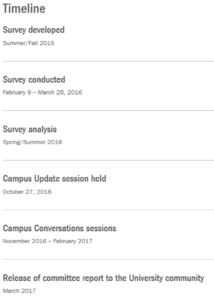
In addition, the University conducts assessments that cut across units and responsibility portfolios. Such assessments allow the University to be responsive in addressing emerging issues of importance to the Syracuse University community and to higher education more broadly. For example, in the summer of 2015, in light of institution-wide strategic planning, nationwide debates about inclusivity on post-secondary campuses, and a recommendation from the Chancellor’s Workgroup on Sexual Violence, Prevention, Education, and Advocacy, the University engaged an outside consultant to work with the Climate Assessment Planning Committee to design, conduct, and report findings from a campus-wide climate assessment (VII.5.003.Climate_Assessment_Site). More than 5,600 students, faculty, and staff completed the resulting survey during February and March of 2016. Several campus-wide update sessions were held in October 2016 focusing on the survey’s executive summary. That was followed by a feedback period and series of public meetings to discuss the draft report before releasing the final report with recommendations in summer 2017. (VII.5.003.Climate_Assessment_Site, see timeline) Since the release of the initial report, recommendations have begun to be implemented, an example of closing the assessment loop.
Areas of Continuous Improvement and Recommendations
Criterion 7.4e discusses engagement with faculty and students concerning the University’s activities and goals. The administration continues to strive to improve its engagement with students, faculty, and staff in regard to some of the more controversial situations and issues. The current senior administration learned early lessons about the importance of ongoing, proactive, clear communication and appropriately timed engagement with the University community, particularly regarding strategic changes aimed at improving the University. The importance of engagement and communication became very clear during the closure of the Advocacy Center in 2014, the establishment of the Provost Promotion and Tenure Advisory Committee in 2015, and the planned construction of the University Promenade (now the Einhorn Family Walk) in 2016.
The University recognizes the need to improve internal communication and engagement and will look to the new senior vice president of communications and marketing to provide strategic leadership in this area. Best practices also might be derived from the engagement approaches used in establishing the University Policy Committee, which involved formal consultation with the Senate, and in establishing a Free Speech Policy, which began with the Working Group on Free Speech and incorporated comments online and included engagement with the Senate. Increasing formal engagement with the Graduate Student Organization, Student Association (undergraduate), Student Bar Association (Law), and other bodies is also critical to ensure that students’ input is being considered. Please see Recommendation 2 in Chapter 5 for further discussion of the University’s communications structure.
Criterion 7.5 refers to periodic assessment of governance and leadership. Although a culture of assessment is developing on campus, the University must continue to make improvements. A systematic assessment process for functional units is now in place, and we are continuing to work toward all administrative units entering Phase Two of assessment, where they gather formal data and analyze it, and Phase Three of assessment, where interpretation and plans for improvement are developed, tracked, and shared based upon the assessment findings. Refinement of assessment goals and objectives should consistently be made based upon the University’s refinement of strategic goals and the implementation plans.
In Chapter 5, Recommendation 1 addresses periodic assessment of governance leadership as indicated for Criterion 7.5. Recommendation 4 pertains to the engagement between the administration and the University community related to the alignment of mission and resources, as well as to matters related to transparency of communication.