Standard IV: Across all educational experiences, settings, levels, and instructional modalities, the institution recruits and admits students whose interests, abilities, experiences, and goals are congruent with its mission and educational offerings. The institution commits to student retention, persistence, completion, and success through a coherent and effective support system sustained by qualified professionals, which enhances the quality of the learning environment, contributes to the educational experience, and fosters student success (I.1.001.MSCHE_Standards_RoA).
Summary Declaration
Based on our review and analysis of documentation, we believe that Syracuse University is in compliance with Standard IV. Syracuse University provides accurate and comprehensive information regarding the cost of attendance, financial aid, scholarships, grants and loans, and the repayment of loans and refund procedures. Syracuse has made improvements both domestically and abroad to provide enhanced academic support for students who are identified as struggling academically by advisors or professors. Engagement in these programs as well as school and college-provided advising services for students aim to help the University to increase persistence, retention and completion rates.
Overview of Satisfactory/Exemplary Criteria
Criterion 4.1a addresses the availability of financial information pertinent to the cost of attendance. Syracuse University is committed to transparency related to the dissemination of information regarding cost of attendance; financial aid, including scholarships, grants, and loans; the repayment of loans; and refund procedures. The University publishes and makes widely available multiple sources of information regarding these items with detailed websites and publications. Chief among these is the annual Tuition, Fees, and Related Policies Bulletin (IV.1.001.Tuition_Fees_Booklet2016-2017). From the moment that a prospective student reaches the University’s website (IV.1.002.Admissions_Site), the admissions area provides information on the cost of attendance (including the net cost calculator). Finally, the Office of Financial Aid and Scholarship Programs and the Office of Student Debt Management offer both information and services to assist students with the financial aspects of their education. As noted in reference to Criterion 2.7, the University’s financial literacy program in the Office of Financial Aid was ranked #3 in the U.S. by LendEDU in 2017 (II.7.005.Financial_Literacy).
Criterion 4.1b calls for processes to support students who are not sufficiently prepared for their selected field of study. Students who are identified as being inadequately prepared have access to a number of programs, services, and resources to assist them in attaining their educational goals, including the Writing Center, the Math Clinic, and the Tutoring and Study Center (recently relaunched with free tutoring services as the Center for Learning and Student Success; IV.1.003.CLASS_Site). Until this new center was launched, tutoring at Syracuse had been available to the general student population only on a fee-for-service basis—an unusual setup for a campus of Syracuse’s size. A November 2017 report indicated that free group tutoring through CLASS between weeks 2 and 13 of the fall 2017 semester was 1,504 visit hours, with students reporting satisfaction with the sessions, which were made available free based on the successful model developed to support Syracuse student athletes.
Center for Learning and Student Success Fall 2017 Participation
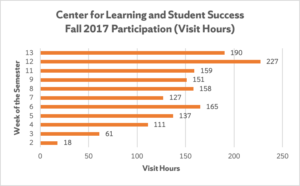
Note: Visit hours were calculated based on the number of hours students spent in a group tutoring session. Sessions last 1 hour each.
Additional support offerings include the Office of Support Services, the Student Success Initiative, the Collegiate Science and Technology Entry Program, the McNair Program, the Office of Multicultural Affairs, and the Stevenson Educational Center for Student-Athlete Development. As an example, the Office of Support Services introduces students to college expectations and provides tailored academic, social, and personal support that helps students enroll, persist, and successfully graduate. The students participate in a SummerStart Program, a six-week summer bridge program where students complete seven to eight credits of coursework prior to their freshman fall semester. For the 2012 Summer Start cohort, students who participated in the program had a four-year graduation rate of 74%. Additionally the persistence rate of the SummerStart cohort starting in 2014 was 85.89%. Note that for assessment purposes, each of the support units listed above is considered a co-curricular unit and as such participates in assessment and action planning on a two-year cycle. Some units—like the Stevenson Center, which is subject to NCAA rules—collect and act upon effectiveness data on an annual cycle.
“SummerStart changed my life. I’ve learned to take initiative and I’ve matured. The program gets you ready for college life in the fall. My classes have been different, dynamic and interactive.” —Maria Jimenez- SummerStart Student
Criterion 4.1c addresses orientation, advisement, and counseling programs. All University students are assigned an academic advisor, although each school and college uses a different model for academic advising. The University provides multiple departments, offices, and services to help guide students successfully through their academic careers. The University employs multiple channels (websites, in-person, social media, etc.) and shared communication streams to deliver orientation, advisement, and counseling information to students. For example, each school and college at Syracuse University has an advising office where students can obtain advice about program choices, course selection, and careers (IV.1.004.Advising_Arts_and_Sciences). In 2016, the University began rolling out two systems pertinent to advising: Orange SUccess and Degree Works. Orange SUccess is an implementation of Hobson’s Starfish Early Alert product that assists with communication among students, advisors, instructors, and staff. From August 2017-November 2017, 32% of undergraduate students had adopted using Orange SUccess, about 20,692 online advising appointments were scheduled through it, and about 66% of all students received flags or kudos through the system.
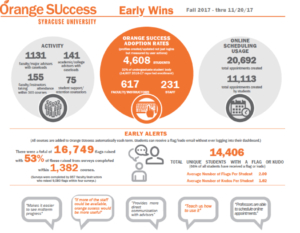
Degree Works is a product for automated checking of degree requirements. As of November 2017, 10,752 students had logged onto Degree Works, and there were 53,000 system interactions among students, faculty and staff.
A voluntary, self-organized committee, known as the Advising Practitioners Forum (APF), meets monthly during the academic year to share beneficial practices and coordinate advising approaches and systems (IV.1.005.Advising_Practitioners_Forum_SU). The APF includes advising professionals from every school/college, and its meetings focus on information and discussions meant to improve students’ advising outcomes. For example, a recent agenda (IV.1.006.APF_MeetingAgenda) from the December 2016 APF meeting indicates that the bulk of the meeting was spent discussing the Starfish campus-wide advising tool (branded as Orange SUccess; IV.1.007.OrangeSUccess_Sample). Feedback from APF participants has been positive saying that it has increased best-practice sharing.
The University also provides an extensive program of orientation emerging from the Office of First-Year and Transfer Programs (IV.1.012.Orientation_Site). Examples of orientation programming include “Ready-Set-SU,” an online guide to making a smooth transition from high school to Syracuse University, as well as the “Syracuse Welcome,” a weeklong program that mixes academic and social programming as students move to campus for the first time. The Office of First-Year and Transfer Programs also provides specialized programming for first-generation college students, transfer students, and members of living-learning communities. For example, residence hall programs that supported academic success in 2014-15 included 180 students and 17 faculty members participating in the faculty meal program; in-hall tutoring for biology and astronomy averaged 10 students per session.
Finally, the University provides multiple pathways for counseling and social support outside of the classroom. About 2,301 students (10.7 percent) utilized the Office of Student Assistance, which (IV.1.013.Student_Assistance_Site) serves as a gateway for many of these services, although students can also find entry points at various offices around campus, such as the Counseling Center and Health Services (IV.1.013.Student_Assistance_Site). Examples of supports available through the Office of Student Assistance include bias-related support, sexual and relationship violence support, medical leave of absence, and emergency loans. Recognizing the positive impact the Office of Student Assistance made with main campus students, Syracuse Abroad in June 2013 created a new position—a case manager—whose role has been to support students and parents throughout all phases of the student experience with Syracuse Abroad. This support encompasses pre-departure preparation as well as during students’ stay abroad, and also includes any necessary follow-up services after students have finished their semester. This case manager provides Syracuse Abroad students with referrals and connections to main campus resources for students and staff abroad. Such resources may include (but are not limited to) involvement with Health Services, Office of Disability Services, Office of Student Assistance, the Counseling Center, Risk Management, General Counsel, the Office of Student Rights & Responsibilities, and visiting student study abroad offices. The case manager provides 24/7 emergency support to directors and staff at the abroad centers in order to address health, disciplinary, safety, and security issues as they arise.
Criterion 4.1d pertains to processes designed to enhance student success like degree completion and post-completion placement. Syracuse University offers an amalgam of support structures, with some centralized services and processes, but with the majority of advising and career services across campus emerging from within the schools and colleges. For example, the Office of Academic Affairs employs a director of retention with campus-wide responsibilities for retention data and systems such as Orange SUccess (an implementation of the enterprise advising platform known as Starfish; IV.1.008.OrangeSUccess_Site). Most of the
frontline work pertaining to advising and degree completion, however, occurs within the advising groups at each school and college. In 2017, all deans created a plan designed to increase graduation rates and have begun sharing best practices based on the retention and academic success work group co-chaired by the 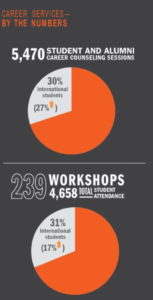 provost and the senior vice president for enrollment and the student experience. Similarly, while the Office of the University Registrar maintains and develops degree audit support with the Degree Works platform (IV.1.009.Degree_Works_Example), students review their audit information in consultation with advisors in each of the schools and colleges. Degree Works is a software program, created by Ellucian, to automate the degree audit process and enable student self-service for exploring degree requirements. As noted above, the rollout of Degree Works to all student groups will complete during the 2017-2018 academic year.
As a parallel example related to post-completion placement, the 2016 TruMann Report (II.9.003.TruMann_Report_Placeholder) characterized the University’s approach to career services as a “combination model” (p. 7). The report provides recommendations that the University is using to make improvements to career services. A central Office of Career Services (IV.1.010.Career_Services_Site) provides some campus-wide services, but almost every school and college employs one or more career services professionals who primarily assist students in that college. About 5,740 students use the central Office of Career Services, and about 4,658 students participate in University career sponsored workshops.
Criterion 4.2 addresses transfer credit as well as credit offered through alternative mechanisms. Syracuse University has a robust set of policies and procedures regarding the evaluation and acceptance of transfer credits, both from external institutions as well as internal transfers between schools and colleges within Syracuse University. Coursework taken at two- and four-year institutions is reviewed by the advising and records offices of the admitting college at Syracuse University. Liberal arts courses are the most likely credit to be transferred, and college advising and records offices consult with individual departments regarding any questions of course equivalencies. In the case of dual majors that include two schools and colleges, the home college is responsible for determining course equivalencies. Guidelines for transfer credit appear on the admissions page (IV.2.001.Admissions_Site) with the Transfer Evaluation System (TES). Major courses almost always require a syllabus and departmental review, especially in the professional schools. A formal credit evaluation is completed after a final transcript is provided by admitted students and approved credits/courses are added to the student’s transcript.
There are approximately 20 partner institutions with which Syracuse University has articulation agreements for transfer credit. Not all schools and colleges at the University participate in all of these partnering agreements. Schools and colleges not covered by articulation agreements rely on individual review of coursework for each student. The Office of Admissions publishes and maintains a list of partnering institutions along with details of each agreement (IV.2.002.Community_Colleges_Partnerships).
Each school and college uses field-of-study norms and New York State Department of Education (NYSED) regulations to determine credits awarded through experiential learning (e.g., internships). An internship office, located in the central Office of Career Services, provides an organized process for students to register an internship for credit (IV.1.010.Career_Services_Site). A subset of schools and colleges also employs professional advisors to assist with internship processes. Professionals in central Career Services and the schools and colleges also facilitate communication between site supervisors and faculty sponsors to determine a final grade and provide required documentation. Recommendations on how to improve internship processes were included in the TruMann Report as well. In concordance with NYSED guidance, the University standard is 45 hours of work completed for each credit hour of internship.
Syracuse University provides a standard for the acceptance of Advanced Placement (AP), College Level Examination Program (CLEP), and International Baccalaureate (IB) credits (IV.2.003.AP_IB_CLEP_Credit_Transfer). Academic departments review tests from time to time and update minimum score requirements as warranted. All schools and colleges use these equivalents when reviewing AP, CLEP, and IB scores for incoming students, for both first-year and external transfers. This uniformity provides a consistent policy in support of first-year students who may choose to internally transfer within SU.
Syracuse University does not accept prior non-academic learning, such as professional experience, as an equivalent to college credit with the sole exception of the Bachelor of Professional Studies program (designed for adult, part-time learners) at University College. Using a portfolio-based evaluation process, University College occasionally awards credit for prior learning to upper division students who document a minimum of five years of relevant professional experience (IV.2.004.Prior_Learning_Assessment).
Criterion 4.3 addresses security of student information. Syracuse University follows applicable laws and has developed policies and procedures for protecting student information and records. HIPAA, FERPA, and general information technology policies governing information protection appear on the University’s policies website (IV.3.001.SU_Policies). In addition to the policies website, University policies and procedures regarding student records can be found in the course catalog under Academic Rules (IV.3.002.Course_Catalog). The Information Technology Services division (ITS) enforces policies granting access to sensitive systems and data and provides strong administrative procedures to control data and records of students.
The University enforces a strict policy regarding contracts with external parties, including contracts that may result in student records and data being shared (IV.3.003.Policies_Contracts_External_Parties, IV.3.004.Policies_ Information_Technology). The policy restricts the authorized signatories of University contracts to specific University officers that include the Chancellor, chief information officer, comptroller, senior vice president and chief financial officer, and treasurer. The Office of the Chief Information Officer provides a contract review process that includes assessment of the external party’s security policy and provision of contractual terms for non-disclosure and data security controls, including agreement to perform all contractual services in compliance with industry and security standards and norms (i.e. CIS Critical Security Controls, NIST 800-53 rev4, ISO 27002- 2013) and to provide evidence of such compliance.
Criterion 4.4 pertains to the academic, fiscal, and administrative principles governing non-academic programs. At Syracuse, athletics, student life, and other co-curricular activities are regulated by the same academic, fiscal, and administrative principles and procedures that govern all other programs. All students, regardless of their classification (i.e., student athlete, students enrolled in the various schools and colleges, international student, etc.), are bound by the same foundational principles and procedures that govern all programs across the University. For example, the Student Code of Conduct (IV.4.003.Code_Ethical_Conduct) applies to all students (note that students of the College of Law are also subject to additional conduct requirements). Recently, the Academic Integrity Policy (IV.4.001.Academic_Integrity_Policy) was updated such that undergraduates and graduates are subject to the same set of rules and procedures. In this context, it is important to note that schools and colleges can and do supplement the essential body of regulations (e.g., regarding student conduct) to address accreditation-specific or industry-specific criteria (IV.4.002.Law_Academic_Handbook_Class_of_2017. pg 53-63).
Criterion 4.5 mandates institutional review and approval of student support services provided by third parties. Note that the contracting process mentioned previously in Criterion 4.3 includes institutional review and approval of all third-party providers but naturally is limited to understanding a vendor’s capabilities prior to the provision of service. In 2016, the Office of Institutional Effectiveness and Assessment conducted a campus-wide survey to identify what proportion of students’ experiences are affected by services provided by a third-party vendor. Results of this survey showed that no third-party vendor provided services affecting 25 percent or more of a student’s academic and co-curricular experiences (IV.5.001.Third_Party_Survey_Data). For example, Syracuse University Athletics utilizes the advising platform known as GradesFirst, and though this involves a third-party vendor that affects students’ academic experiences, the services do not impact more than 25% of a student’s academic experience, thus not qualifying for institutional review.
Criterion 4.6 addresses periodic assessment processes for the student experience. As mentioned in the review of Standard IV Criterion 4.1d above, the University has assessed various aspects of the student experience, as evidenced by the TruMann Report of Career Services (II.9.003.TruMann_Report_Placeholder) and the Climate Survey (II.5.003.Climate_Survey_Placeholder). Please review the following section for more detailed information about Standard IV Criterion 4.6.
Areas of Continuous Improvement and Recommendations
As noted above, Criterion 4.1c focuses on orientation, advisement, and counseling programs for students, whereas Criterion 4.1d focuses on processes to support completion and placement. While Syracuse offers a wide range of relevant student support services, recent assessment evidence such as the 2016 TruMann Report, (II.9.003.TruMann_Report_Placeholder), an external report related to career advising, suggests that the decentralized nature of the University’s student support mechanisms causes “navigational hazards”—student difficulties in finding the right service at the right time—and inequities based on differences in service levels among schools and colleges. As a result, student support services across campus are varied, such that students may have different experiences depending on who their advisor is and the school or college in which they are enrolled. Similarly, graduate students and undergraduate students often have different experiences—even within a single school or college—depending upon the particular programs and staffing arrangements for that unit.
Efforts are underway to address these challenges. For example, the Division of Enrollment and the Student Experience has a new assistant provost and dean of student success, whose portfolio includes providing central coordination of career services and intra-university transfer advising in order to smooth the service inconsistencies students may be experiencing. In addition, the first ever Intra-University Transfer Fair in spring 2017 represented a step toward a better experience for students in the intra-university transfer process. The Campus Framework (IV.1.011.Campus_Framework_Overview) facilities planning process has led to design and preliminary construction for the “Arch,” a retrofit of Archbold Gymnasium as a facility that will provide “one-stop” services to address students’ health and wellness needs; funding has since been secured and construction has started. Additional steps have been taken to create “one-stop” shops around some administrative functions and offices used frequently by students, such as locating the registrar, housing, meal plan, and ID card services near the main quad (Steele Hall), as well as creating a Center for Learning and Student Success to serve as a centralized home for academic support services. Following recommendations of the TruMann report, a reorganization and refocusing of career services will put all of the University’s career support professionals on a common data platform and establish campus-wide standards for reporting. One of the key goals emerging from the report lies in establishing a minimum standard of care in career services for students from all levels and all schools and colleges.
While these ongoing efforts will benefit students, the University recognizes the need to further improve the consistency of student support resources, based on indirect assessment feedback from students. With respect to advising, the decentralization of information leads to a scattering of resources, which in turn makes it difficult for students to find help where and when it is needed. Additionally, information currently posted on various advising-related websites is not comprehensive, and not all resources are accessible. These tasks are being shared with the Advising Practitioners Forum.
With respect to Criterion 4.6—the periodic assessment of the effectiveness of programs supporting the student experience—the University undertakes assessments, studies, and internal or external evaluations of various relevant programs. A list of recent evaluations includes:
- The Bain Report (2013), a broad overview of all campus administrative and financial functions (IV.6.001.Bain_Innovation_Opps_Slides)
- The TruMann report of the Office of Career Services (2016; II.9.003.TruMann_Report_Placeholder)
- An external evaluation of the Renée Crown Honors Program (2016; IV.6.003.Final_Syracuse_HP_Review_Placeholder)
- A self-study of Hendricks Chapel (II.9.004.Hendricks_Report_Placeholder) prepared in advance of a nationwide search for a new dean of the chapel (IV.6.002.Hendricks_Chapel_Dean_Search_Committee)
As the list above might suggest, these large-scale comprehensive reviews are typically undertaken following a prolonged period of regular operations. In addition to the large-scale reviews, more focused assessments are periodically conducted. Recent examples include:
- Analysis of the effect of study abroad on graduation rates (IV.6.004.SUA_Grad_Rates_Propensity_Score_Analysis)
- Analysis of the effect of the Student SUccess Initiative on graduation rates (IV.6.005.Grad_Rates_SSUI_Participation)
Prior to the establishment of the Office of Institutional Effectiveness and Assessment in 2014, we lacked a central administrative mechanism to ensure regular and periodic assessment of effectiveness. Now all support units for the student experience are required to participate in either functional or co-curricular assessment depending on their unit type. Over time, this requirement will help to align the activities of each unit with the academic strategic plan and to ensure that we provide high value to our students.
The University’s assessment system provides a consistent schedule by which staff collect information and evidence, interpret results, determine whether action is necessary, and if applicable, measure the impact of any actions taken. Assessment efforts are documented by each unit and provided to the Office of Institutional Effectiveness and Assessment during the annual progress reporting window from July 1 through mid-September. The University’s expectations for sustaining assessment are clearly articulated. Units will sustain a well-designed and manageable assessment and action plan and process to inform decision-making, and a unit’s entire set of outcomes/objectives will be assessed over a four-year cycle to determine if unit goals have been achieved.
Staff members from 108 co-curricular and functional areas on campus have been highly engaged with the University’s systematic assessment initiative, from plan development in 2014-15 to implementation over the last two years. As of this writing in December 2017, 100% of co-curricular and 94% of functional units have filed assessment and action plans that link unit goals and objectives to performance. Based on our regular tracking of assessment activity, 97% of co-curricular units and 83% of functional units are implementing the plans they filed. Each of these units has developed recommendations for improvement in their reports.
In addition, the dean’s office in each school/college has developed an assessment and action plan that covers areas not otherwise assessed: business operations and financials, student services, advancement, communications, and recruiting. Implementation of these plans begins in 2018 and will advance the schools’ and colleges’ efforts to support the student experience and foster student success. In Chapter 5, Recommendation 1 addresses periodic assessment as described in Criterion 4.6. Additionally, Recommendation 3, which focuses on enhancing the student experience for all Syracuse University students, addresses improvement opportunities related to Criterion 4.1c and Criterion 4.1d.