Standard VI: The institution’s planning processes, resources, and structures are aligned with each other and are sufficient to fulfill its mission and goals, to continuously assess and improve its programs and services, and to respond effectively to opportunities and challenges (I.1.001.MSCHE_Standards_RoA).
Summary Declaration
Syracuse University has appropriate planning processes, human resources, and other resources available to support our institutional mission. Existing strategies qualitatively and quantitatively measure the utilization of resources on a regular basis. Using a Responsibility Center Management (RCM) budgetary model, the University ensures that planning and improvement are guided by our institutional vision, mission, and goals as articulated in the initiatives of Fast Forward Syracuse. Our annual planning processes consider current and long-term infrastructure, facilities, technology, and overall student experience goals. Therefore, we believe, based on the evidence we have reviewed, that Syracuse is in compliance with Standard VI.
Overview of Satisfactory/Exemplary Criteria
Criterion 6.1 addresses clarity of institutional objectives and their assessment as linked to the University’s mission and goals. Under the academic strategic plan’s (I.1.002.Trajectory_to_Excellence) foundational principle of One University, Syracuse University has begun the transition from a highly decentralized institution with unusual autonomy at the unit level (school, college, administrative, and auxiliary) into a more judiciously coordinated institution focused on achieving unit-level objectives linked to a common mission, vision, and goals. These institutional objectives are used for planning and resource allocation.
In 2013, upon the recommendation of the University Senate and the approval of the Board of Trustees, we invited the consulting firm Bain & Company to develop an Innovation and Opportunities Assessment Report (IV.6.001.Bain_Innovation_Opps_Slides). This highly detailed data collection and analysis process identified a need for the University to develop and execute a new institutional vision—a recommendation that prompted the University’s leadership to launch the campus-wide planning effort. The leadership commissioned the simultaneous development of three plans:
- An academic strategic plan (I.1.002.Trajectory_to_Excellence) that would articulate overarching mission, goals, and strategies for the University as an educational and research institution;
- A facilities master plan (IV.1.011.Campus_Framework_Overview), a comprehensive framework establishing a vision for enhancing academic excellence and the student experience by creating a vibrant campus setting; and
- An efficiency and cost-containment initiative (VI.1.001.Fast_Forward_Syracuse _ Operational_Excellence), an effort to increase effectiveness, control expenditures, and improve business practices as a means to generate savings for investment in the academic strategic plan and the facilities plan.
The design of the University’s assessment planning process ensures that unit-level plans appropriately reflect the institution-level mission and goals established in the academic strategic plan. Academic, co-curricular, and functional units start with a mission statement and contain the fundamental elements of goals, outcomes or objectives, strategies, criteria, results, and actions following from the results. Each assessment and action plan is scored on several criteria, including “Action & Follow-Up,” or identification of changes based on assessment results, as well as measurement of the impact of the action. On a 3-point scale, the scores for the Action & Follow-Up sections of the plans average 2.2 for Functional Units, 2.2 for Co-Curricular Units, and 1.6 for Academic Units.
Criterion 6.2 focuses on the use of planning and improvement processes as well as constituent participation in those processes. As noted above under Criterion 6.1, over the past four years Syracuse University has undertaken major planning and improvement processes, each of which has invited input from and participation by all University constituencies. Of particular note is the academic strategic planning process, which was preceded by an assessment of innovation and opportunities (IV.6.001.Bain_Innovation_Opps_Slides) conducted specifically to inform development of the strategic plan. Below, we present three additional examples of the University’s participative planning process.
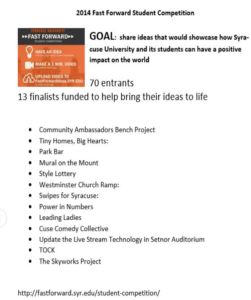
1) Fast Forward Syracuse. The three-pronged effort comprising the academic strategic plan, a facilities plan, and an operational efficiency plan was highly collaborative, with representation from a broad variety of University constituencies. Evidence was collected, analyzed, and discussed in public forums, and feedback for the academic strategic plan and Campus Framework was solicited through surveys, forums, and focus groups; feedback for all three initiatives was solicited via the Fast Forward website (VI.2.001.Fast_Forward_Syracuse). A description of the process for developing these documents appears on the Fast Forward website. Likewise, information on initiatives implemented from the recommendations of Operational Excellence can also be found on that website.
2) Assessment. The Office of Institutional Effectiveness and Assessment was established in 2014 to coordinate assessment efforts across campus. Assessment plans are continuously operative (VI.2.002.Assessment_Dashboard) for academic, co-curricular, and functional units. Each assessment plan serves as a building block for future improvement and unfolds in an annual process with three phases: Phase One–Specify and Plan; Phase Two–Collect and Analyze; Phase Three–Action and Follow-up. Within each academic, co-curricular, and functional area, the office provides an overarching structure for assessment methods, supplies templates and rubrics to assist the process, and applies the annual schedule of activities with the cooperation of the provost, deans, chairs, and program leaders. For instance, Phase One for an academic program always includes student learning outcomes, measures, and criteria. An example assessment plan from the Retail Management BS degree in the Whitman School of Management (VI.2.003.Whitman_MAR_RetailManagement_BS_AAPlan) illustrates the standard template used by degree programs. The third phase of the assessment process documents use of assessment results.
To help inform the University community of these processes, as well as to establish a common vocabulary for assessment and promote positive practices, the Office of Institutional Effectiveness and Assessment hosts regular workshop events for faculty and staff. The office maintains a website (VI.2.004.Institutional_Effectiveness_Assessment) where faculty, staff, and University partners can learn about the assessment philosophy at Syracuse, the various committees working to implement a cohesive approach to assessment, training opportunities, technology to support assessment, and information resources. Perhaps the most important work of the office occurs in “house calls”—periodic visits by assessment staff to departments, faculty meetings, and individual offices to provide tailored assistance with assessment processes. These house calls also give faculty and staff opportunities to provide feedback on assessment methods and progress, which in turn is used by the Office of Institutional Effectiveness and Assessment to improve its own operations.
3) Diversity and Inclusion. Diversity and inclusion are core institutional values that reflect the University’s longstanding belief that a diversity of perspectives, life experiences, and beliefs among students, faculty, and staff is essential to academic excellence. Diversity and inclusion are also cornerstones for attracting and retaining the best faculty and staff. In the fall of 2015, Chancellor Syverud appointed a Workgroup on Diversity and Inclusion to develop solutions that support a diverse and inclusive campus climate for all. This workgroup comprised faculty, undergraduates, graduate students, and staff. The workgroup was charged with building on the work of other campus groups and, guided by the academic strategic plan, making recommendations to help “sustain an inclusive, accessible campus of opportunity for a richly diverse student body.” The workgroup submitted its report on March 11, 2016 (VI.2.005.Workgroup_Diversity_Inclusion_Final_Report). The report includes 33 recommendations. Among those is the creation of a Diversity and Inclusion Council, which the Chancellor established in September 2016; free academic tutoring options for Syracuse students; and a central funding mechanism for accommodations. More information on initiatives related to advancing diversity and inclusion can be found on our diversity and inclusion web portal (VI.2.006.Diversity_Inclusion_Site). In spring 2017, free group tutoring had been launched through CLASS as described under 4.5; other initiatives have been piloted or launched.
Criterion 6.3 considers linkages between the University’s financial planning processes and our mission, goals, strategic plans, and objectives. As noted in the 2013 Periodic Review Report, the University instituted a Responsibility Center Management (RCM) budgeting model in 2006-2007 to create a system that is accountable and responsive to the centers that are responsible for generating revenues. The financial planning and budgeting process is a close collaboration between the University executive leadership (including the Board of Trustees), the Office of Budget and Planning (Budget Office), and the units (i.e., schools, colleges, and auxiliary units) across campus. Consider the following overviews of four major budgeting processes:
- Undergraduate Tuition: Revenues from undergraduate tuition are the single largest revenue source in the University’s budget. The Office of Enrollment Management, the schools and colleges, and the Office of Budget and Planning work closely to establish undergraduate admissions targets in alignment with University goals and objectives. Multiple strategic planning sessions are held annually with the executive leadership and the schools and colleges, during which detailed enrollment plans are outlined and analyzed (VI.3.001.Undegraduate_Enrollment_Tracking).
- Graduate and Master’s Tuition: The Office of Budget and Planning works collaboratively with each school and college to ensure enrollment goals are reflected in the consolidated budget plan. Progress toward the established goals is measured and tracked through applications, acceptances, and student yield.
- Salaries: Resource allocations for salaries represent the largest expense for the University and are closely monitored for both faculty and staff. The Faculty and Staff Search Approval Processes (VI.3.002.Faculty_Search_Approval_Process_Placeholder) exemplify how faculty and staff review processes ensure that all new faculty and staff hiring is in alignment with the University’s mission and goals.
- Indirect Charges: The University’s RCM budget model allocates income and charges direct and indirect expenses to each responsibility center (VI.3.003.Syracuse_University_RCM_Placeholder). The University conducts annual model assessments and solicits feedback from stakeholders for potential changes to ensure that allocation methodologies align with the University’s strategic plan.
With more than 10 years of RCM experience, we consider our budgeting process to be “mature.” At the same time we examine and analyze the parameters and mechanisms of RCM each year. Feedback from stakeholders leads to continuous self-improvement in our planning and budgeting processes. For example, the allocation of tuition funds was improved in the 2016-2017 academic year to promote teaching across departmental boundaries by allowing revenue to “follow the instructor” instead of the course prefix. In another example, the Budget Office now requests that each responsibility center include with its submitted budget appropriate documentation that reflects how that budget supports both the University’s academic strategic plan and the unit’s plan. In response to requests from the Board of Trustees, a 10-year, long-range projection budget plan is now required from the units to ensure resource allocation decisions are made with consideration of the eventual financial impacts (VI.3.004.Ten_Year_Forecast_Placeholder).
Criterion 6.4 addresses the adequacy of the University’s finances, talent, infrastructure, and technology. In the material below, we document that Syracuse University possesses all of the resources needed to support its operations at our main campus in Syracuse, at our satellite locations domestically and internationally, and online.
Fiscal Resources. Syracuse University’s revenues come from undergraduate tuition, graduate tuition, law tuition, auxiliary revenues, sponsored financial aid, academic initiatives, grants, contracts, endowment distributions, and gifts. These sources serve and support all units across the University community in the areas of salary, fringe benefits, operation and equipment, capital projects, undergraduate financial aid, graduate and law financial aid, debt service, and other expenses (VI.4.001.Annual_Financial_Reports _ Comptroller). The Office of Budget and Planning deploys and manages these financial resources while strategically promoting fiscal stability and accountability (VI.4.002.Office_Budget_and_Planning). As reflected in the Annual Financial Reports, our expenditures remain consistently within the bounds of our revenues.
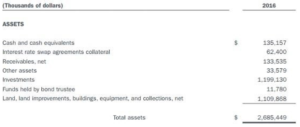
Excerpt from Annual Financial Report
Human Resources. The Syracuse University workforce is notable for its talented, engaged, and diverse members, who contribute to the University’s mission across a broad range of endeavors. The University employs 1,165 full-time faculty and 3,245 full-time staff and is the second largest employer in the Central New York region. In addition, the University has a part-time workforce of 592 faculty and 279 staff. A subset of staff members participates in one of three collective bargaining units (VI.4.003.Bargaining_Unit_Staff), while part-time faculty members participate in Adjuncts United. In 2015-16, 254 staff members participated in a voluntary retirement incentive program to help reduce the operating loss of $13 million in 2014, and the University deemed it as successful. The voluntary retirement program enabled the University to avoid involuntary terminations. Since then, the University has shifted resources to hire new staff where strategically needed.
The Office of Human Resources (HR) provides leadership and service to the University community in the areas of employee benefits, compensation, recruitment and hiring, workforce diversity, employee relations, work-life balance, professional development, training, student employment, and employee recognition (VI.4.004.Human_Resources_Site). HR strives to eliminate discrimination in all its forms, intentional or inadvertent, with respect to all personnel decisions, procedures, and actions, including compensation, benefits, transfers, layoffs, returns from layoff, University-sponsored training, education, tuition assistance, and social and recreational programs (VI.4.005.HR_Policies_Procedures).
In 2016 and 2017, HR engaged in a structural transformation to establish a cadre of senior business partners who physically spend time in the schools and colleges. These individuals serve as local HR leaders, providing strategy, advice, and guidance to senior academic leaders (e.g., school/college deans) as well as to central administrative leaders. The structural transformation also included the creation of Centers of Expertise and Shared Services to improve quality and responsiveness of HR services.
Physical Infrastructure. Syracuse University’s 683-acre main campus hosts the academic quadrangle, Hendricks Chapel, the Carrier Dome indoor athletic facility, and a broad range of other academic, residential, and administrative buildings. The University also maintains physical presences in downtown Syracuse, New York City, the District of Columbia, and Los Angeles, as well as eight overseas centers through Syracuse Abroad. The ongoing development of the Campus Framework facilities plan and the work of a steering body known as the Campus Facilities Advisory Board guide the maintenance and strategic improvement of all University physical facilities. This work drives the use of the capital asset management plan, which follows the guidelines of the Association of Physical Plant Capital Renewal and Deferred Maintenance Programs (Kaiser, 2009; VI.4.006.APPA_Leadership_Educational_Facilities). With this strategy, the long-term forecasting of physical assets is planned in conjunction with the more immediate needs related to infrastructure improvement through the use of a facilities life cycle model database. This tool facilitates appropriate budgeting and short- to long-term forecasting to guide University leadership in making decisions with highly accurate projections of need and cost as they relate to physical infrastructure. The overarching goals of the Campus Framework (IV.1.011.Campus_Framework_Overview) address our aspirations:
- Supporting academic excellence: Strengthen learning and investigation by creating 21st century academic and research environments across the University.
- Enriching all aspects of student life: Foster student success through a holistic student experience, engaging student life centers, comprehensive academic and administrative supports, and a diverse array of health and wellness offerings.
- Creating a vibrant campus setting: Continue to enrich the environment with high-quality place making, buildings, and landscapes, distinguished by design excellence.
Technology. The University operates a massive wireless and wired network, along with thousands of servers, hundreds of enterprise software applications, and a full range of instructional technologies (VI.4.007.ITS_Home). The Information Technology Services unit (ITS) advances technological expertise and innovation, cultivates data-driven decision-making, and promotes institution-wide operational excellence in a number of ways. ITS provides planning for accessible technologies and services that energize teaching and learning; empower research excellence with a dynamic portfolio of computing capabilities and resources; deliver robust, highly available, leading-edge information technology and infrastructure; safeguard and leverage the University’s data and devices, and those of students, faculty, and staff; and maintain fiscally responsible governance and management of all information technology assets. Through ongoing assessment, the unit demonstrates and continues to improve its capacity to provide accessible technologies and services that energize teaching and learning.
ITS employs a participative governance structure, at the center of which is the Technology Leadership Council (VI.4.008.ITS_TLC_Home). The TLC comprises members from the central ITS organization working together with IT representatives of schools, colleges, and administrative units. Within the schools and colleges, at least one member of each unit’s IT staff has a dual reporting line to ensure accountability both to the respective dean and to the standards, policies, and practices promoted by ITS.
Criterion 6.5 pertains to the University’s decision-making processes and accountability. As a large, complex organization, Syracuse University combines localized autonomy for unit-level operational decisions with clear, centralized lines of authority for substantive decisions affecting student safety and welfare, University finances, facilities, personnel matters, and academic investments. For example, the Syracuse Abroad centers have robust safety protocols and facilities plans; yet the University’s central offices of Risk Management, Business Finance and Administrative Services provide guidance and uniformity. The University Senate plays an advisory role to the Chancellor and provost (as well as other members of the senior leadership team), particularly on decisions with long-term implications for the health of the institution. As ex officio members of the University Senate, the Chancellor and the provost meet regularly with committees and the full Senate to gather feedback and share information. These meetings help improve communication, transparency, input for decisions, and accountability. During Chancellor Syverud’s term, he has increased efforts to solicit input and suggestions more broadly from University constituencies and to consider these perspectives in University decision-making.
University Leadership. To promote communication and coordination of decisions, Chancellor Syverud established three interlocking leadership units: the Chancellor’s Executive Team, the Chancellor’s Council, and the University Leadership Team. The Executive Team comprises the provost, the Chancellor’s chief of staff, and the senior vice presidents (e.g., of Advancement and External Affairs). Organizational charts and the Chancellor’s website describe the responsibilities of those leaders (VI.5.001.Chancellor_Executive_Team_Site). The Chancellor’s Council adds to the Executive Team the deans, associate provosts, and key division leaders (e.g., the chief information officer and the executive vice president of the Division of Campus Safety and Emergency Services; VI.5.002.Chancellor’s_Council_Site). Finally, the University Leadership Team also includes unit directors from auxiliaries and an expanded range of academic leadership (e.g., associate deans; VI.5.003.Chancellor_University_Leadership_Site). All three units meet regularly to communicate, engage with, and advance the goals embodied in the academic strategic plan. The Chancellor utilizes input from these teams as well as the Board of Trustees in all decision-making.
Board of Trustees. As explained more fully in Criterion 7.4 under Standard VII, the Board of Trustees serves as the governing body for the University. The Chancellor meets regularly with the Board of Trustees and its component committees. The board has seven standing trustee committees: Investment and Endowment, Athletics, Advancement, Audit, Student Affairs, Academic Affairs, and the Executive Committee. A full listing of trustees and committee members appears on the trustee website (VI.5.004.BoT_Site). The Chancellor provides the board with a data dashboard to demonstrate progress on implementing goals.
University Senate. The University Senate differs from advisory bodies on some other campuses as it comprises members elected from the faculty (n=122), staff members (n=17), graduate and undergraduate students (n=9), and members of the administration appointed by the Chancellor (n=12, VI.5.005.University_Senate_Homepage). These administrators serve as ex officio members of the University Senate and are participants in its committee structure in the areas that closely match their administrative duties. Both Chancellor Syverud and Provost Wheatly are members of the University Senate Agenda Committee, which sets the Senate agenda and monitors the work of the Senate committees. The Senate does not have a president, but the chair of the Agenda Committee has a broad remit and serves as chair for full body meetings. The Chancellor and provost have reported regularly to the Senate about plans and initiatives and increasingly have included members of the Senate on administratively appointed committees and task forces. The University Senate generally acts in an advisory role; however, it has a formalized decision-making role with respect to curriculum, academic program approval, and promotion/tenure processes. The Senate serves as a powerful voice for expressing the concerns of the broader campus community and as a sounding board for the administration in its attempts to develop, implement, and assess policy and other initiatives. The Senate has been increasingly involved in discussions of policy changes and initiatives, Fast Forward strategic planning, and other campus-wide initiatives such as those focusing on diversity and inclusion.
Criterion 6.6 addresses comprehensive planning for facilities, infrastructure, and technology. Syracuse University has implemented a comprehensive evaluation and plan for facilities, infrastructure, and technology. This plan considers issues of sustainability and deferred maintenance. The plan links to strategic and financial planning processes and is closely aligned with guidance from the Association of Physical Plant Administrators Capital Renewal and Deferred Maintenance Programs (Kaiser, 2009; VI.4.006.APPA_Leadership_Educational_Facilities). Annually, we undertake facility condition assessments and development of a facilities renewal plan to reduce deferred maintenance, linking that facilities renewal plan to financial and strategic planning processes, and strengthening institutional planning structures to align functional improvement with facilities renewal.
A campus facilities assessment of main campus and south campus has been completed, and the results are stored in our facilities life cycle model database (VI.6.001.CPDC_Site).This database serves as the basis for facilities renewal plans. Financial planning features of this tool provide facility condition needs index projections based on future year budgets to quickly demonstrate facility condition improvement or degradation over time as a function of investment level. We use an integrated planning process to target deferred maintenance in a sustainable and fiscally responsible manner. The continued development of the Campus Framework and creation of the Campus Facilities Advisory Board facilitate linkages between facilities renewal plans and functional improvements. The Campus Framework, as a guiding document, and the Campus Facilities Advisory Board, as a decision-making body, support scheduling of facilities renewal alongside planned major renovations and functional improvements.
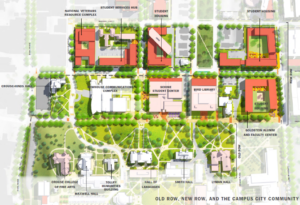
Excerpt of Campus Framework facilities plan showing proposed new buildings in orange.
Technology sustainability planning is supported in a similarly systematic way with the targeted goal of supporting the academic strategic plan (also see criterion 6.4). Ongoing annual activities include:
- Network Master Plan—A multi-year capital project for the upgrade and maintenance of campus-wide wireless and wired network infrastructure;
- Annual Registrar classroom technology upgrade that funds registrar classroom technology upgrades on a planned five- to seven-year replacement life cycle (in collaboration with Campus Planning, Design, and Construction);
- Research computing infrastructure—The Research Computing Advisory Council (comprising faculty and IT staff) defines the needs, funding, and implementation of new research computing infrastructure;
- Technology in Residence Halls—Large-scale technology upgrades in residence halls are part of broader capital project planning (in collaboration with Campus Planning, Design, and Construction);
- Makerspaces and Digital Scholarship spaces to support innovation in teaching and scholarship;
- Enterprise system planning—Selection, implementation, and upgrade of enterprise-wide application systems (for example, Blackboard); ongoing enterprise-wide system maintenance costs are managed via a central account that is augmented annually to address annual increases in software maintenance costs.
The annual budgeting process includes consideration of both the current and long-term needs for facilities, infrastructure, and technology. The budgeting process, as described in Criterion 6.3, aids in prioritization of which projects to undertake annually.
Criterion 6.7 focuses on annual financial auditing. Syracuse University ensures completion of independent financial audits annually as well as an audit of federal programs. Both of these audits are currently completed by the national auditing firm KPMG LLP. The auditing firm is appointed each year by the Audit Committee of the Board of Trustees. The financial statements for each of the past 10 years indicate no material weaknesses or significant deficiencies. Independent audit results from 2001 up to the most recently completed fiscal year appear on the comptroller website (VI.4.001.Annual_Financial_Reports _ Comptroller).
The University’s chief financial officer and comptroller are responsible for preparing the financial statements in accordance with generally accepted accounting principles. The auditor’s responsibility is to conduct the audit in accordance with generally accepted auditing standards and plan and perform the audit to obtain reasonable assurance about whether the financial statements are free of material misstatement. The auditor’s approach to the financial statement audit focuses on internal controls and performing detailed transaction testing with respect to routine and non-routine transactions and accounting estimates. The audited financial statements consist of the statement of financial position, statement of activities, statement of cash flows, and related footnotes. The statement of financial position identifies the University’s net assets, and the statement of activities provides a snapshot of the current year activity for both revenues earned and expenditures incurred. The statement of cash flows provides details on cash receipts and cash payments for the year.
The A-133 audit is a federally required audit. The required Statement of Expenditures of Federal Awards and the accompanying notes present information on the University’s federal sponsored grants, including financial aid, research and development, and other activities. The A-133 audit is designed to include all procedures and reports necessary to satisfy the requirements of the Federal Uniform Guidance. KPMG uses standardized audit programs developed from the federal government’s “Compliance Supplement” to ensure that its procedures meet federal standards. The audit program includes procedures to determine: whether the University has designed an effective internal control structure over its major federal programs; whether those controls are operating effectively; and whether the University has complied with applicable regulations in administering its federal programs. No material weaknesses or significant deficiencies have been identified for the past 10 years.
Criterion 6.8 focuses on strategies to measure and assess the utilization of institutional resources. Based on the evidence provided below, we conclude that Syracuse University has developed and deployed strategies to measure and assess the adequacy and efficient utilization of institutional resources required to support our mission and goals. The Operational Excellence initiative represented an important milestone in the University’s efforts toward efficiency. Likewise, the creation of the Office of Institutional Effectiveness and Assessment (VI.2.004.Institutional_Effectiveness_Assessment) in 2014 has enabled a more systematic approach to assessment campus-wide. Finally, the Office of Audit and Management Advisory Services (VI.8.001.AMAS _ Site) provides periodic checkpoints for effective resource utilization across administrative units.
A standard institutional process for assessing functional units began in FY2015 and is documented on our assessment website (VI.2.002.Assessment_Dashboard). University-wide and unit-based approaches have been developed to evaluate the institutional resources to support our mission and goals as they relate to planning, resources, and improvement of fiscal and human resources, as well as physical and technical infrastructures.
A three-phase process unfolds over a biennial cycle. Phase One of the assessment cycle for functional units, which included defining unit goals, objectives, and key performance indicators, occurred in 2016. Key performance indicators (KPIs) include a range of quantitative and qualitative data sources, which are obtained through University-wide data stores, stakeholder and community surveys, and rubrics developed to evaluate University unit-level outcomes. Phase Two, initiated at the end of 2016, involves collecting assessment KPIs and evaluating them. Phase Three, focusing on implementing program and operational improvements, opens this spring (2017) and will continue into 2018, after which the whole cycle will begin anew. Similarly, co-curricular and academic program assessment plans have followed the same phases though more closely tied to the academic year calendar. In all cases, we set the expectation that academic, co-curricular, and functional units will discover ways that resource allocation can shift to better meet unit objectives. In the material below, we provide a small set of examples to illustrate the co-curricular unit assessment process:
- Syracuse Abroad. This co-curricular unit provides international education experiences for Syracuse University students as well as for students from other institutions. An assessment and action plan was submitted that included goals related to adequacy of infrastructure support for Syracuse Abroad (VI.8.002.SU_Abroad_AAPlan). Phase Two Key Performance Indicator data are being gathered in 2017 in parallel with a strategic planning process for the unit. Syracuse Abroad will undertake recommended action steps (Phase Three) in 2018.
- The Renée Crown Honors Program. The honors program, located in the College of Arts and Sciences, requires that student participants demonstrate competencies in global awareness, civic engagement, and collaborative capacity. In fall 2016, an external team from the National Collegiate Honors Council conducted a formal program review and submitted recommendations to the Office of the Provost. In 2016, the honors program developed an assessment and action plan that includes goals related to the adequacy of course offerings, instructional faculty, and collaboration with University admissions to increase enrollments (VI.8.003.A&S_Honors_Program_AAPlan).
- The Mary Ann Shaw Center for Public and Community Service. The Shaw Center promotes, supports, and facilitates academic-related community engagement as an essential component of the Syracuse University learning experience. In 2016, the Shaw Center developed an assessment and action plan that focuses on functional operations (VI.8.004.Shaw_Center_AAPPlan). Similar to Syracuse Abroad, the Shaw Center is gathering Phase Two KPI data in 2017 in parallel with a strategic planning process for the unit. The Shaw Center will undertake recommended action steps (Phase Three) in 2018.
Other campus-wide units, including the Office of Residential Life, Office of Disability Services, and Office of Multicultural Affairs, have assessment plans that help measure the adequacy of resources for diversity and inclusion initiatives and the impact of those initiatives. For example, the Office of Residence Life offers 30 residence-based academic learning community options to first-year and returning students. Physical space, staff, and faculty mentors are dedicated to these communities. The University is committed to promoting a positive campus atmosphere and environment to support the achievement of University outcomes, including positive educational experiences, healthy identity development, and a sense of value for all faculty and staff members.
Criterion 6.9 addresses periodic assessment of the effectiveness of planning and resource allocation. Syracuse University has recently undertaken a complete assessment of these areas. In its report to the University Senate in February 2013 (and refined in its April 2013 report), the University Senate Budget Committee recommended and the Senate endorsed an outside review of the University’s RCM budgetary practices and a comparison to peer institutions. With support from the administration and the approval of the Board of Trustees, Bain & Company was retained to conduct this review between December 2013 and February 2014. The resulting diagnostic review (the Bain Report) was provided to the University community in April 2014 (VI.9.001.Innovation_and_Opportunities_Assessment_Report). Subsequent planning, including the Fast Forward Syracuse initiative’s Campus Framework and academic strategic plan components (see Criterion 6.1 of this Standard VI), reflect the recommendations in the Bain Review as well as subsequent feedback from the broader University community and University leadership, including the Board of Trustees. The ongoing implementation and evaluation efforts that have resulted are signature elements of the University’s efforts in this area.
One area where the University undertakes regular, periodic assessment of planning and resources allocation is in the area of financial planning. The Responsibility Center Management (RCM) budgeting process requires an annual assessment of the financial performance of each responsibility center (i.e., schools, colleges, and auxiliary units). The RCM budgeting model implicitly serves as a means of monitoring the planning and expenditures of the responsibility centers. The Chancellor has recently asked all responsibility centers to extend their budget planning model to a 10-year period to more fully monitor their progress toward meeting their goals and expenditures (VI.3.004.Ten_Year_Forecast_Placeholder).
Periodically the University undergoes a faculty salary review process. Documentation of prior analyses can be found at http://suaaup.org/salary.htm. Most recently, a Faculty Salary Review Committee was charged by Provost Wheatly to review trends in faculty salary data, including differences by rank, discipline, race/ethnicity and gender. The Committee finalized its report in fall 2017 and released it to the campus community in December 2017.
The Syracuse University Board of Trustees Audit Committee (VI.9.002.Audit_Committee_Charter) is responsible for the oversight, review, and approval of both internal and external auditing of the University’s financial statements. As indicated in the response to Criterion 6.7 and the accompanying documents, KPMG has found no material weaknesses or significant deficiencies.
The University Senate Committee on Budget and Financial Affairs receives and evaluates budgetary information (VI.9.003.Budget_Committee_Report2014), monitors budgetary issues, and serves as a forum for feedback to the central administration on budgetary issues. The Budget Committee reports regularly to the University Senate, which serves as a forum for discussing budgetary issues and disseminating budgetary information to the broader University community.
Areas of Continuous Improvement and Recommendations
As noted above, both Criterion 6.1 and Criterion 6.9 address periodic assessment of plans, resources, and processes. While the University up to 2013 had an informal, voluntary approach to assessment of goals and objectives, we have since moved to establish systematic processes and methods needed to develop reliable and regular assessments of curricular, co-curricular, and functional units. Assessment of institutional objectives has been more sharply focused as a result of the academic and administrative planning processes developed and implemented under Chancellor Syverud and, more recently, under Provost Wheatly. Assessment occurred prior to the arrival of Chancellor Syverud, but typically in reaction or in response to leadership changes or shifts in organizational or operating models. The examples of the Bain Report and the TruMann Report, discussed more fully above, serve as indicators of this approach.
While considerable progress has been made in linking institutional and unit-level goals and objectives to mission and vision and to one another, the University must continue to implement robust assessment plans, respond to the outcomes, and track responses to them on a regular cycle. Additionally, we must continue to clearly articulate ties between University resources, assessment evidence, and responses to assessment outcomes that emerge as part of these ongoing efforts. In light of the new mission and vision emerging from the academic strategic plan developed in 2014-15 (with implementation strategies developed in 2015-16), many opportunities now exist to establish the “One University” described in the sixth pillar of the academic strategic plan. Recommendation 1 in Chapter 5 contains a variety of action plans that pertain to periodic assessment, thereby addressing opportunities related to Criterion 6.1 and Criterion 6.9.
Criterion 6.3 pertains to financial planning that is aligned with the University’s mission and goals. The University continues to develop graduate enrollment models that provide more granular predictions at the program level, which should allow for more accurate forecasting of graduate revenues. We recognize the need to continue working to improve our approach to connect graduate enrollment planning and strategic goals with the academic strategic plan. While schools and colleges have historically managed their own graduate programs and enrollments with substantial autonomy, considerable opportunity exists for the University to provide data, processes, and coordination to facilitate development of enrollment targets and ensure that the targets are achieved. Early in 2017, the provost and the senior vice president for enrollment and the student experience convened a strategic enrollment task force with broad campus representation. Meanwhile, all graduate and master’s education programs have received detailed reports from the Graduate School’s enrollment management team and are being challenged to incorporate both competitive analyses and trend data into their planning processes.
Criterion 6.5 addresses well defined decision-making processes and accountability. Recognizing that many senators and others have expressed a desire for more direct involvement in institutional decision-making, the University has committed to increasing the involvement of the Senate in the University’s choices and actions. This commitment has been demonstrated through the policies and procedures that were revised with Senate input in 2016 and through this Middle States self-study review process, which generated many ideas for improvements relevant to the work of the Senate and its constituent committees. Under the leadership of Chancellor Syverud and Provost Wheatly, the University must continue to build productive partnerships with the University Senate. Recommendation 4 focuses on the alignment of resources with the missions and strategic plans of the individual units as well as the whole University. These actions address opportunities related to Criterion 6.3 and Criterion 6.5.