The Self Study Process
Syracuse University conducted a comprehensive self-study process addressing the Middle States Commission on Higher Education (MSCHE) Standards for Accreditation, Requirements of Affiliation, and Compliance with Accreditation-Relevant Federal Regulations. With the arrival of a new provost and under the guidance of the academic strategic plan, this has been an opportune time to strengthen our institutional improvement efforts. Information acquired from the self-study process has provided us with the opportunity to recommit to areas of strength and identify opportunities for renewal and growth. In particular, the self-study process has provided the platform to engage a broad swath of the campus community in a critical self-evaluation of the University’s educational programs, student services, and administrative units.
We established eight self-study teams to address the seven MSCHE standards plus accreditation-relevant federal regulations. Each team included co-chairs: one faculty member and one administrator. The team rosters included faculty and staff with experience and/or duties that prepared them to address the standards or compliance criteria. The teams also included at least one undergraduate and graduate student. All teams reported to a Steering Committee comprising faculty, staff, students, and administrators. At least one of the co-chairs from each of the self-study teams served on the Steering Committee.
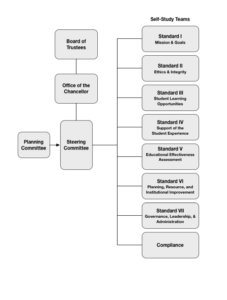 Steering Committee – Oversaw the self-study process and coordination of self-study teams; reviewed progress and intermediate work relating to the self-study
- Planning Committee – Organized logistics for all teams and the Steering Committee; supported development of the self-study document and its supporting document repository
- Self-Study Team 1 – Standard I
- Self-Study Team 2 – Standard II
- Self-Study Team 3 – Standard III
- Self-Study Team 4 – Standard IV
- Self-Study Team 5 – Standard V
- Self-Study Team 6 – Standard VI
- Self-Study Team 7 – Standard VII
- Self-Study Team 8 – Compliance
Each self-study team had a charge to examine relevant documents, processes, procedures and structures; analyze strengths and weaknesses with regard to the criteria of their assigned standard; and suggest improvements to be undertaken. Each team conducted its initial review between September and December of 2016 and provided a team report to the Steering Committee. Clarifications occurred during January and February of 2017, with preliminary drafting of the self-study document occurring in parallel. The membership of each of the self-study teams appears in Table 3.1 below.
Table 3.1: Self-Study Team Membership
| Standard I: Mission and Goals
Shiu-Kai Chin (co-chair), James Duah-Agyeman (co-chair), Christopher Finkle, Bea Gonzalez, Maurice Harris, Nicole Hill, Claudia Klaver, John Petosa, Brian Sheehan, David Smith, Stuart Taub, Dominick Fantacone, Peter Choi |
Standard II: Ethics and Integrity
Grant Reeher (co-chair), Margaret Usdansky (co-chair), Susan Dean, Sharon Dotger, Rosemary Kelly, Ebonish Lamar, Steve O’Keefe, Mark Rupert, Jim Shahin, June Szymanski, Margaret Thompson, Lydia Wasylenko, Nathan Elequin, James Franco |
| Standard III: Student Learning
Kira Reed (co-chair), Jenny Gluck (co-chair), Mark Braiman, Karen Bull, Jill Christian-Lynch, Aracely DeRose, Rachel Fox von Swearingen, Aileen Gallagher, Mary Graham, James Henderson, Eileen Lantier, Amy Sloane-Garris, Murali Venkatesh, Terra Peckskamp, Will Geoghegan, Gokce Greg Serdar, Joyce LaLonde |
Standard IV: Student Experience
Dan Cutler (co-chair), Amanda Eubanks Winkler (co-chair), Giovanna Albaroni, Tammy Bluewolf-Kennedy, Kim Brown, Jamie Cyr, Julie Walas Huynh, Melissa Luke, Sarah Mack, Karen McGee, Judith Mower, Paula Possenti-Perez, Dave Sargalski, Marsha Senior, Kal Srinivas, Mark Trumbo, Ryan Williams, Rodlyn Yafetto, Sudan Zhuang |
| Standard V: Assessment
Kathy Hinchman (co-chair), Tommy Powell (co-chair), Terriruth (TC) Carrier, Gabby Chapman, Laura Harrington, John Kulak, Linda Milosky, Michael Morrison, Dawit Negussey, Megan Oakleaf, Anne Osborne, Patricia Roylance, Dan Moseson, Samantha Howard |
Standard VI: Planning/Resources
Bruce Carter (co-chair), Jean Gallipeau (co-chair), John Beecher, Nicci Brown, Cyn Carnahan, Andy Clark, Chris Cofer, Amy Criss, Ronald Denby, Keren Henderson, Gwenn Judge, Kathy Kinney, Roger Merrill, Jamie Mullin, Elin Riggs, Peter Sala, Maureen Thompson, Shanique Mothersill, Michael Ryan |
| Standard VII: Administration
Lisa Dolak (co-chair), Ping Zhang (co-chair), Hub Brown, Tony Callisto, Kelly Chandler-Olcott, Cheryl Ficarra, Herman Frazier, Mary Lovely, Chris Wildrick, Aakriti Sharma, Abdulaziz Al-Sulaiti |
Requirements/Compliance
Abby Perer (co-chair), Michaele DeHart (co-chair), Joseph Behan, Jim Bellini, Steve Block, Sanjay Chhablani, Stephen Colicci, Catherine Cornwell, Aaron Hodukavich, Hua Jiang, Judith Kopp, Pam Peter, Shelly Sipley, Mark Wheeler, Diana Napolitano, Nicole Cooter, Eric Evangelista, Peta Long |
The Steering Committee included a broadly representative cross-section of faculty, staff, and students. At least one co-chair from each self-study team was a member of the Steering Committee. The members of the Steering Committee appear alphabetically below along with each person’s role or position at the University:
Abdulaziz Al-Sulaiti, Undergraduate Student Representative
David Bartell, Executive Director of Outreach Programs
Craig Boise, Dean and Professor
Carol Boll, Staff Writer and Researcher
Bruce Carter, Associate Professor
Shiu-Kai Chin, Professor, Provost’s Faculty Fellow
Gabe Coleman, Project Manager
Dan Cutler, Director of Learning Communities, Associate Dir. Office of Residence Life
Michaele DeHart, Interim Dir., Office of Risk Management and Regulatory Compliance
Lisa Dolak, Professor, Senior Vice President and University Secretary
James Duah-Agyeman, Director, Office of Multicultural Affairs
Gerald Edmonds, Assistant Provost – Institutional Effectiveness and Assessment, Executive Director, Project Advance
Jerry Evensky, Professor
Jean Gallipeau, Comptroller
Jenny Gluck, Associate Chief Information Officer
Kathleen Hinchman, Associate Dean, Professor
Can Isik, Senior Associate Dean, Professor, Senate Agenda Committee Chair
Candace Campbell Jackson, Vice President, Chief of Staff
Rajesh Kumar, President, Graduate Student Organization
Melissa Lowry, Administrative Specialist, Office of Institutional Effectiveness and Assessment
Joan Nicholson, Trustee
Abby Perer, Associate General Counsel
Kira Reed, Associate Professor
Grant Reeher, Professor
Sam Scozzafava, Vice President, Chief Information Officer
Pamela Socker, Director of Compensation Strategy
Sonia Suchak, Undergraduate Student Representative
Tommy Powell, Assistant Provost, Stevenson Center for Academic Support
Margaret Usdansky, Director, Center for Learning and Student Success
Amanda Eubanks Winkler, Associate Professor
Ping Zhang, Professor, Provost’s Faculty Fellow
Both the Steering Committee and the Planning Committee were led by “tri-chairs” that included a faculty leader, a staff leader, and the University’s accreditation liaison officer:
- Rochelle L. Ford, Ph.D., Professor and Chair of the Public Relations Department at the S. I. Newhouse School of Public Communications
- Elizabeth A. (“Libby”) Barlow, Ed.D., Assistant Vice President of Institutional Research and Assessment
- Jeffrey M. Stanton, Ph.D., Professor of Information Studies and Associate Provost for Academic Affairs, Accreditation Liaison Officer
With leadership by the tri-chairs, the Steering Committee fulfilled the following roles:
- Establishing and charging teams for each standard and coordinating their work on the various issues to be studied;
- Ensuring that the accreditation timetable was implemented as planned;
- Assuring communication within the institution about the self-study process, including periodic updates to the provost, Chancellor, and Board of Trustees;
- Approving distribution versions of the self-study document;
- Arranging for institution-wide review of and responses to a draft of the self-study;
- Overseeing the completion of the final self-study report and any other documents relevant to the self-study process and team visit.
Likewise, the Planning Committee undertook the following activities in support of the reaccreditation process:
- Providing administrative support (e.g., scheduling, venues, documentation) for the Steering Committee and each of the standards teams;
- Managing the document repository, including receiving and fulfilling documentation requests from the standards teams;
- Supporting the submission and editing of team reports; and supporting the creation of the final self-study report;
- Providing referrals to subject matter experts on campus;
- Creating the arrangements for site visits.
In transforming the team reports into the self-study, the tri-chairs undertook a writing process that focused on preserving all substantive points raised by the team reports. In general, these substantive points fell into one of four categories:
- Documentary evidence and arguments for the University’s satisfactory status on a standard or on an individual criterion within a standard;
- Suggestions for facilitating improvement where evidence suggested that the University has ongoing processes or activities that are already addressing areas of improvement;
- Recommendations for improvement where a body of evidence across multiple criteria and/or standards suggested that the University should undertake new improvement initiatives;
- Promising projects and neat ideas that fall outside the scope of the Standards for Accreditation.
The narrative contained in the present document addresses items A, B, and C above, with items A and B discussed in Chapter 4 and item C in Chapter 5. Material pertaining to Item D on the list appears in a compendium of promising ideas that we have affectionately labeled the “parking lot.” During the self-study writing process in 2017, the tri-chairs and the Steering Committee shared the parking lot ideas with a variety of constituencies across campus.