Standard II: Ethics and integrity are central, indispensable, and defining hallmarks of effective higher education institutions. In all activities, whether internal or external, an institution must be faithful to its mission, honor its contracts and commitments, adhere to its policies, and represent itself truthfully (I.1.001.MSCHE_Standards_RoA).
Summary Declaration
Syracuse University has adopted policies and procedures designed to ensure that the University operates with ethics and integrity. The University also has organizational structures, such as the Office of Audit and Management Advisory Services, the Conflict of Interest Committee, and the Senate Committee on Academic Freedom, Tenure, and Professional Ethics, designed to execute, monitor, and maintain these policies and procedures. We conclude from the evidence we have collected and reviewed that Syracuse is in compliance with Standard II.
Overview of Satisfactory/Exemplary Criteria
Criterion 2.1 discusses academic and intellectual freedom as well as intellectual property rights. Freedom of expression and intellectual freedom raise thorny issues, never fully resolved and always contestable, and like other institutions of higher learning, Syracuse University has wrestled with these issues through evolving historical contexts. The University holds academic freedom as a bedrock value and a necessary condition for the fulfillment of its mission. Members of the University community have frequently wrestled with these thorny issues in an open manner. The University provides an environment for critical self-examination of these issues.
Syracuse University’s Faculty Manual embodies the University’s commitment to academic and intellectual freedom (II.1.001.Faculty_Manual). The Statement of Principles on Academic Freedom and Tenure by the American Association of University Professors is incorporated into Section 5 of the Faculty Manual and is excerpted in Section 3.51:
“Faculty are entitled to full freedom in research and in the publication of the results, subject to the adequate performance of their other academic duties; but research for pecuniary return should be based upon an understanding with the authorities of the institution.”
Section 4 of the manual describes the role of the Senate Committee on Academic Freedom, Tenure, and Professional Ethics, a standing committee of the University’s primary shared governance body that adjudicates complaints related to academic and intellectual freedom. Section 3 of the manual describes the University’s stance on intellectual property. This section includes a description of the roles and responsibilities of the standing Committee on Intellectual Property, a body that consults with and advises the vice president for research.
In addition to the policies themselves, evidence of our commitment to their content can be found in formal discussion of these issues by the University Senate (II.2.006.DiversityInclusion_senate-minutes_2016-03-23) and in messages to the community from the Chancellor (II.2.008.Chancellor_Syverud_Free_Speech) in which he clearly states, “free speech is and will remain one of our key values.”
Criterion 2.2 pertains to establishing and maintaining a positive campus climate. The University fosters respect among students, faculty, staff, and administration from a range of diverse backgrounds, ideas, and perspectives starting with its mission and vision (I.1.002.Trajectory_to_Excellence, pg.3). In messages such as an email to the community (II.2.007.Chancellor_Syverud_Inclusion), University leadership clearly states that Syracuse University values “open and respectful dialogue, dedication to academic freedom and the search for truth, and a promise to include all voices, to listen to all viewpoints, and to embrace all members irrespective of race, ethnicity, nationality, religion, gender, gender identity, sexual orientation, citizenship, disability, veteran-military status, and political views.”
The vision of an “inclusive, student-focused research university” manifests in the third goal of the University’s mission statement: “fostering a richly diverse and inclusive community of learning and opportunity.” The University supports a range of offices, committees, and initiatives to pursue this element of its mission and address other factors essential to sustaining a positive campus climate. For example, as attested by the annual reports (II.2.001.Div_of_Student_Affairs_2014-2015_Annual_Report) of the Division of Student Affairs (recently renamed the Division of Enrollment and the Student Experience), the division includes the LGBT Resource Center, the Office of Multicultural Affairs, the Office of Student Assistance, the Office of Student Rights and Responsibilities, the Slutzker Center for International Services, the Disability Cultural Center, and the Office of First-year and Transfer Programs. All of these offices and many others play important roles in supporting the University’s commitment to diversity and inclusion, and to supporting and sustaining a welcoming campus climate for all. In a similar vein, the Office of Equal Opportunity, Inclusion and Resolution Services (II.2.002.Equal_Opp_Inclusion) helps to foster an environment of respect through its monitoring and investigation of concerns related to discrimination, harassment, ethics violations, and matters related to Title IX.
The strategies and actions of these offices have been informed by a variety of signature campus initiatives. For example, in 2015 the University’s leadership commissioned the Workgroup on Diversity and Inclusion (II.2.003.Chancellor’s_Working_Group_Diversity_Inclusion_News) to develop solutions on how to further create a more diverse, inclusive campus climate. A public status report from August 2016 shows progress and actions taken on the workgroup’s 18 recommendations (II.2.004.Chancellor’s_Working_Group_Diversity_Inclusion_Status). The University also conducted a campus climate survey by an independent firm to gauge attitudes on how welcoming and respectful the campus environment is from a diverse range of perspectives; and it developed human resources policies establishing processes and expectations for University employees—two initiatives that further illustrate institutional commitment to ethics and integrity.
| Syracuse University Climate Strengths and Success | |
| 72% | Faculty, staff and graduate student respondents are comfortable with department/work unit climate |
| 79% | Faculty and student respondents are comfortable with the climate in their class |
| 90% | Staff respondents feel Syracuse is a good place to work |
| 75% | Student respondents feel valued by faculty in the classroom |
Excerpt of Findings from the Campus-Wide Climate Assessment
Criterion 2.3 addresses grievance policies and procedures. The University has developed, documented, and implemented a wide range of policies and procedures that address grievances from students, faculty, and staff. With respect to grievance procedures for students, a unified compendium covering all the mechanisms by which students may register complaints and seek redress appears on the University’s main website (II.3.001.Student_Grievance_Processes). Included in this policy is a clearly stated objective that “resolutions are reached in a fair and just manner.” With respect to staff grievances, the University has a Staff Complaint Process Policy that Syracuse University Human Resources publishes, implements, and updates periodically (II.3.002.Staff_Complaint_Policy). Human Resources also serves as the interface to the labor unions whose members are involved in University operations. Each union provides a grievance process to members based on its bylaws and its contractual terms with the University. With respect to faculty, the University’s Faculty Manual governs those grievances relevant to faculty activity and the mechanisms for handling them. See the discussion of Criterion 2.1 above for more information about the Faculty Manual and the Senate Committee on Academic Freedom, Tenure, and Professional Ethics.
Criterion 2.4 speaks to the regulation of conflicts of interest. The University has an overarching conflict-of-interest policy that applies to all employees (II.4.001.COI_Policy). Annually, each employee must complete a conflict-of-interest survey (II.4.002.COI_Survey) that documents potential conflicts of interest and any existing conflict mitigation plans. The Office of Audit and Management Advisory Services analyzes results of this survey and flags necessary actions based on reports of potential conflicts. Additionally, the Office of the Vice President for Research implements a “Conflict of Interest and Commitment for Principal Investigators and Senior Personnel on Sponsored Programs” policy that addresses financial conflicts of interest related to research engagements. An additional annual survey goes out to all individuals engaged in sponsored research (II.4.003.COI_Online_Reporting_System_Instructions). The vice president for research appoints a Conflict of Interest Committee (COIC), consisting of five full-time faculty members, that monitors principal investigators, annual survey results, and records related to externally funded projects.
Criterion 2.5 focuses on fair personnel practices. Syracuse University Human Resources implements a documented set of HR policies and procedures (II.5.001.HR_Policies_and_Procedures). These include elements specifying that Syracuse will:
“. . . conduct its personnel policies, practices, procedures, and programs in a bias-free manner. It is hereby reaffirmed that the policy of Syracuse University is to recruit, employ, renew, retain, tenure and promote employees on the basis of ability, potential, and valid qualifications without regard to race, color, creed, religion, sex, gender, national origin, citizenship, ethnicity, marital status, age, disability, sexual orientation, gender identity and gender expression, veteran status, or any other status protected by applicable law to the extent prohibited by law. Furthermore, Syracuse University shall not discriminate against any disabled employee or applicant in regard to any position for which the employee or applicant is otherwise qualified.”
The Office of Equal Opportunity, Inclusion and Resolution Services offers a confidential reporting service by which individuals may report harassment or discrimination related to creed, ethnicity, citizenship, sexual orientation, national origin, gender, pregnancy, disability, marital status, political or social affiliation, age, race, color, veteran or military status, religion, domestic violence status, genetic information, or gender identity, expression or perceived gender.
The Office of the Associate Vice President for Inclusion, Community, and Citizenship within the Division of Enrollment and the Student Experience implements a bias incident reporting form and associated procedures known as the “Stop Bias” program (II.5.002.STOP_Bias). The Faculty Manual governs all matters connected with the periodic evaluation of faculty performance, as well as criteria and procedures for promotion and tenure. The University Senate Committee on Appointment and Promotions periodically reviews and maintains those elements of the manual, while the associate provost for faculty affairs has day-to-day responsibility for ensuring that schools and colleges implement the manual’s policies and procedures. The Senate Committee on Appointment and Promotions also hears procedural grievances related to appointments, promotion, and tenure.
Criterion 2.6 addresses honesty and truthfulness in internal and external communications. Both the Division of Public Affairs (which includes Syracuse University News Services) and the Office of Marketing and Communications follow a policy titled “Ethics and Integrity in University Communications” (II.6.001.Marketing_Communications_Policy). Syracuse University Information Technology Services also publishes and monitors an acceptable-use policy governing all information technology resources (II.6.002.Acceptable_Use_Policy). While a policy alone cannot ensure honesty and truthfulness in communications, many checks and balances exist on statements and data released by the University. Examples include the University Senate, which plays an active role in shared governance and whose members have monthly opportunities to question the provost and Chancellor, as well as the Daily Orange, the University’s student-run newspaper.
Criterion 2.7 pertains to affordability and access to the University’s educational programs as appropriate to mission. As is true at other private, high-intensity research universities, the trustees and administration of Syracuse University follow the national dialog concerning the affordability and value of a college education. Many differing perspectives exist with respect to assessing the value of a college education; Syracuse appears from time to time on rankings and lists of high value institutions, such as the 2016 Forbes list of the top 300 “Best Value Colleges” (II.7.004.Forbes’_Best_Value_2016). In the interest of promoting affordability, annual tuition increases are monitored closely, and the University provides substantial scholarships and other educational financing options to undergraduate and graduate students. For example, in the fiscal year ending on June 30, 2016, Syracuse provided a total of $307,663,000 in financial aid to its students (II.7.007.Financial_Report_2016).
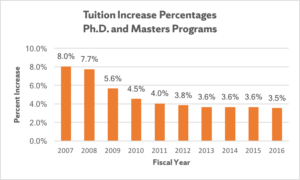
The University also provides students and their families with transparency concerning the cost of attendance. The Office of the Bursar annually updates a tuition and fees booklet that provides comprehensive documentation of the University’s charges for educational services (II.7.001.Tuition_Fees_Booklet). In compliance with federal law, the University provides access to the “Net Price Calculator” (II.7.002.Net_Price_Calculator) that allows students to project what their actual attendance cost and financial contribution would be based on family income. The University’s HEOP Office provides access to federal grants for low-income students.
Using a self-service website (II.7.003.Financial_Aid_Office), and with the assistance of dedicated staff members from the Office of Financial Aid, the University also supports the financial literacy of students and families with information about FAFSA, scholarships, guaranteed loans, savings, credit card debt, and personal financial management. In 2017, the University’s financial literacy program in the Office of Financial Aid was ranked #3 in the U.S. by LendEDU (II.7.005.Financial_Literacy).
Criterion 2.8 incorporates by reference the Middle States Commission’s Requirements of Affiliation and the variety of federal, state, and commission regulations. Section 4.8 of this document addresses Syracuse University’s compliance in all areas covered by Criterion 2.8.
Areas of Continuous Improvement and Recommendations
Criterion 2.2 stresses the importance of a “climate that fosters respect” among members of the University community. As noted above, with the assistance of Rankin and Associates the University conducted a comprehensive climate survey during spring semester 2016 that sought information on working, living, and learning conditions on campus. While the results of the climate survey, reported in September 2016, highlighted positive aspects of the Syracuse campus, the survey was also helpful in identifying areas in need of more attention and discussion (II.5.003.Climate_Survey_Placeholder). On October 25, 2016, the editorial board of the Daily Orange (student-run campus newspaper) commented that:
“Heading into this next phase, the hope should be that apart from highlighting the necessity of the chancellor’s workgroup, the report can guide the university as it moves forward with its recommendations through informed decisions. And with a strong resource like the survey underscoring the importance of the work left undone on the Hill, SU has the opportunity to do just that.”
The results of the survey—all of which were made public based on an agreement with Rankin and Associates—revealed five opportunities for improvement:
- Members of certain constituent groups indicated that they had experienced
exclusionary, intimidating, offensive, and/or hostile conduct from other members of the campus community based on gender identity, position status, or ethnicity
- Individuals who identified with certain non-majority groups (e.g., based on gender identity, racial identity, sexual identity, or disability status) indicated that they were less comfortable than members of the majority group with the overall campus climate, workplace climate, and classroom climate
- Some faculty and staff respondents reported challenges with work-life issues
- Some faculty respondents reported challenges with faculty work
- A small but meaningful percentage of respondents reported unwanted sexual experiences
A committee of faculty, staff, and students appointed by Chancellor Syverud held a number of open conversations (e.g., II.2.005.Conversation_Toolkit) with members of the campus community to review and discuss the survey results. Based on those conversations, the committee produced a set of action recommendations (II.2.009.CAPC_Recommendations). The recommendations have been accepted by the Chancellor and released to the community, and implementation is now underway. Recommendations include a coordinated education strategy for campus climate-related issues, forming an advisory group for staff climate matters, adopting a communication strategy supporting educational efforts, establishing a first-year forum that introduces climate topics to students, and continuing to assess the climate in order to measure progress. The first reassessment is taking place in spring 2018.
Criterion 2.3 addresses grievance policies and procedures; as discussed above, the University has sufficient policies and procedures pertaining to students, staff, and faculty. Historically, however, the University has not developed a unified method of monitoring the timeliness and uniformity of executing its grievance policies and procedures. In February 2017, the University established a student grievance committee, with representatives of each relevant area meeting from time to time to develop and apply standards for quality metrics, record-keeping, trend analysis, and reporting. Likewise, both the University Senate and the Office of Human Resources have incorporated into their assessment plans methods for monitoring and improving the quality of their work related to grievance resolution (II.3.003.HR_Functional_AAP_Phase 1; II.3.004.University_Senate_AAP).
Criterion 2.6 addresses the veracity of communications in announcements, advertisements, recruiting materials, admissions materials, admissions practices, and internal communications. Over recent years, communications at Syracuse University emerged from two different divisions. The Division of Public Affairs reported directly to the Chancellor and had primary responsibility for internal communications, media communications through its oversight of News Services, interactions with the press, and crisis communications. The Office of Marketing and Communications reported to the Division of Enrollment Management and had primary responsibility for external, marketing-focused communications to prospective students, their families, and other constituencies to which the University markets its educational programs. In December 2016, Chancellor Syverud announced the creation of a new position, senior vice president of communications and marketing, and completed a search to fill that role. The Chancellor has tasked the new leader with unifying these two areas and aligning their diverse functions, including branding, web and social media, and internal and external communications. Having a single position that reports directly to the Chancellor also offers the opportunity to ensure consistent oversight of the veracity of all University communications.
Criterion 2.9 refers to periodic assessment of policies, processes, and practices related to ethics and integrity. Prior to 2014 the University lacked a dependable mechanism for triggering periodic assessment of co-curricular units and functional areas. Since 2014, the Office of Institutional Effectiveness and Assessment has pursued its mission, “to provide University leadership and coordination of institutional effectiveness and assessment,” by supporting the development of strategic plans, assessment plans, systematic program review, evaluation criteria, and scoring rubrics (II.9.001.Office_Institutional_Effectiveness).
At this writing, at the end of 2017, 94% of functional units have filed Assessment and Action plans with the Office of Institutional Effectiveness and Assessment. Using a scoring rubric, staff members from the office provide feedback and coaching to each functional unit about improving their plans. Our periodic follow-up with these functional units shows that 83% of functional units are actively implementing their assessment and action plans.
Meanwhile, some of the larger functional and co-curricular units have also engaged in strategic planning activities to ensure that their work is aligned with the overall academic strategic plan. For example, the Division of Enrollment and the Student Experience and the Department of Human Resources are both engaged in the development of strategic plans that will lead to recommendations for continuous improvement over coming years.
Assessment of University-wide policies and practices has occurred—as indicated by the work of the Chancellor’s Workgroup on Diversity and Inclusion (II.9.002.Diversity_Inclusion_Status), the TruMann Report (II.9.003.TruMann_Report_Placeholder), the Hendricks Chapel Self-Study (II.9.004.Hendricks_Report_Placeholder), and other examples. Note that the methods of ensuring a regular rhythm of assessment and improvement only became ingrained with the establishment of the Office of Institutional Effectiveness and Assessment in 2014. Prior to that, there was no central administrative mechanism to ensure that regular assessment occurred.
All four recommendations in Chapter 5 will foster improvements in Criterion 2.2, Criterion 2.3, Criterion 2.6, and Criterion 2.9. First, Recommendation 1 offers a range of actions to enhance and sustain assessment activities to address Criterion 2.9. Recommendations 2 and 3 both commit to improvement of the student experience at Syracuse and will address issues related to Criterion 2.2 and Criterion 2.3. Recommendation 4 strengthens the alignment of resources with the missions and strategic plans and contains actions related to transparency, thus addressing the veracity of communications as described above for Criterion 2.6. Note that the accreditation Steering Committee reviewed all of the relevant evidence and deemed that issues related to Criterion 2.5 did not rise to the level of a recommendation.